DDoS Disclosure Gaps: What Three VPS Providers Publish—and What They Leave Unquantified
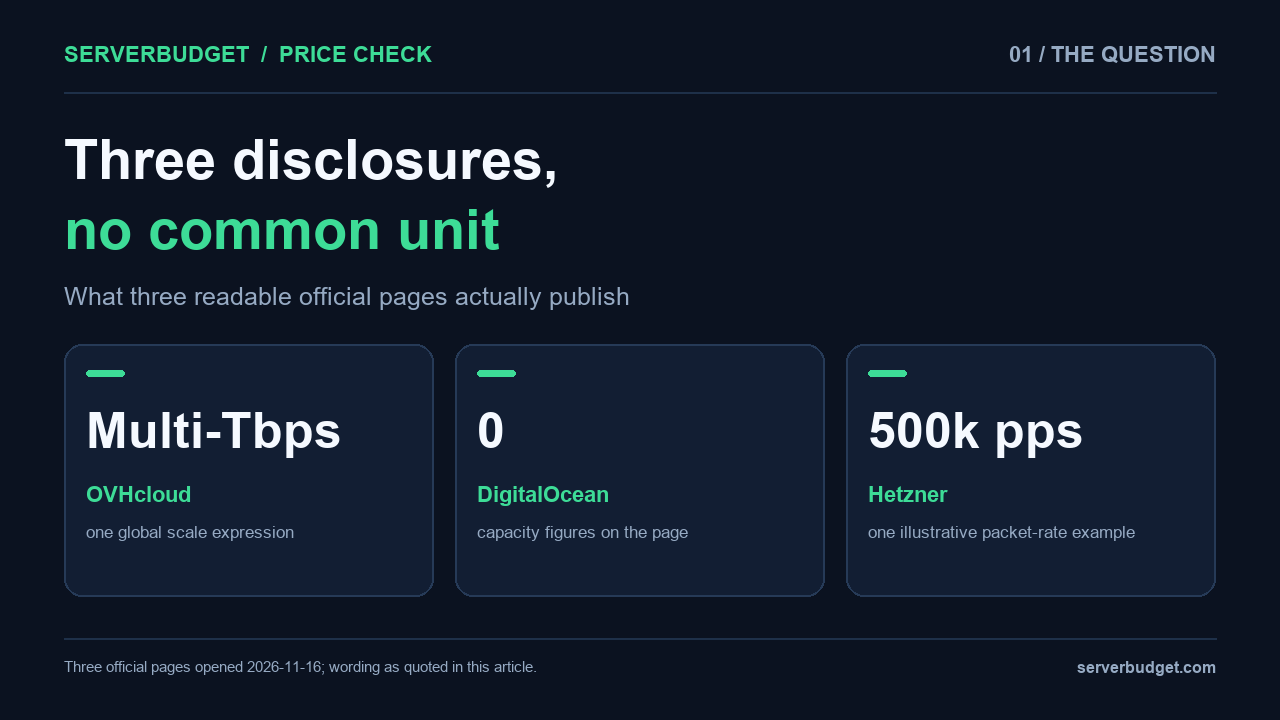
Short answer: On 2026-11-16, three providers with readable official pages publish different kinds of DDoS disclosure and none of them states a per-VPS or per-IP capacity number: OVHcloud gives one global "Multi-Tbps" scale expression plus an "in seconds" mitigation phrase, DigitalOcean gives zero capacity figures but does state what happens above capacity (the address is blackholed), and Hetzner gives one illustrative "500k pps" packet-rate example that it never labels as a limit. Two more providers in this comparison set could not be read at all today, so their cells are marked not readable with the reason instead of being filled with a guess. The honest comparison is about disclosure boundaries, not about which network absorbs the largest attack.
| Provider | Capacity / timing figures published on the official page | Scope explicitly stated on the official page | Numeric limit fields not stated | Official source and check date |
|---|---|---|---|---|
| OVHcloud | One global scale expression, "Multi-Tbps capacity for global attack filtering", and one qualitative timing phrase, mitigation "enabled in seconds" with no exact duration. Both are page disclosures, not a measurement of one server. Derived count by this article: 1 scale expression + 1 timing phrase. [S1, checked 2026-11-16, official Anti-DDoS page] | The Anti-DDoS page says "Each and every OVHcloud product and solution is protected" and names DDoS, packet floods incl. SYN flood, spoofing, malformed or amplification attacks; the VPS page says "Enhanced security with anti-DDoS and backup included". [S1][S2, checked 2026-11-16, official Anti-DDoS and VPS pages] | No guaranteed capacity for one VPS or one IP, no exact mitigation-time number, no VPS-specific SLA figure on the pages read. [S1][S2, checked 2026-11-16, official Anti-DDoS and VPS pages] | https://www.ovhcloud.com/en/security/anti-ddos/ [S1] and https://us.ovhcloud.com/vps/ [S2]; both opened 2026-11-16, HTTP 200. |
| DigitalOcean | Zero capacity or response-time figures on the page read. Its "layers 3-4" wording is a protocol-layer label, not a capacity number. Derived count by this article: 0 capacity figures. [S3, checked 2026-11-16, official DDoS Protection page] | The page calls protection free, built-in and always-on, and names Droplets, Kubernetes, Managed Databases, Load Balancers and assigned Reserved IPs across all its data centers. [S3, checked 2026-11-16, official DDoS Protection page] | No numeric mitigation capacity or threshold. Its FAQ does answer what happens when traffic exceeds capacity: the IP is blackholed, all incoming traffic is dropped until the traffic subsides, then the account owner is notified. The point at which that happens is not quantified. [S3, checked 2026-11-16, official DDoS Protection page] | https://www.digitalocean.com/products/ddos-protection [S3]; opened 2026-11-16, HTTP 200. |
| Hetzner | One illustrative packet-rate expression, "500k pps", used to contrast a UDP flood with a SYN packet example; the page does not call it a maximum, threshold or guarantee. Derived count by this article: 1 illustrative expression. [S4, checked 2026-11-16, official DDoS-Protection page] | The page says protection is free of charge, has not caused costs or prices to increase, and is available to all customers; it names DNS reflection, NTP reflection, UDP floods on port 80, SYN floods, DNS floods and invalid packets. [S4, checked 2026-11-16, official DDoS-Protection page] | No maximum mitigation capacity, no numeric threshold, and no Cloud-tier-specific commitment in the DDoS page body read today. The word Cloud appears in site navigation, not in the DDoS body. [S4, checked 2026-11-16, official DDoS-Protection page] | https://www.hetzner.com/unternehmen/ddos-schutz/ [S4]; opened 2026-11-16, HTTP 200. |
| Contabo | Not readable, checked 2026-11-16: measured locally HTTP 403, a security-check page asking for JavaScript and cookies, no product body retrieved. No figure is used. | Not readable, checked 2026-11-16: same HTTP 403 challenge, no scope statement obtainable. No claim is made about what this provider does or does not offer. | Not readable, checked 2026-11-16: same HTTP 403 challenge, no limit disclosure obtainable. | https://contabo.com/en-us/vps/ ; checked 2026-11-16, HTTP 403 (measured locally), no quotable body. |
| Not readable, checked 2026-11-16: measured locally HTTP 403, a network-security page requiring login or a developer token, no discussion body retrieved. No figure is used. | Not readable, checked 2026-11-16: same HTTP 403 login wall, no scope statement obtainable. | Not readable, checked 2026-11-16: same HTTP 403 login wall, no limit disclosure obtainable. | https://www.reddit.com/r/SelfHosting/comments/1quq7t0/cheap_vps_hosting_best_lowcost_providers/ ; checked 2026-11-16, HTTP 403 (measured locally), no quotable body. |
The counting rule behind the table is this article's own derived arithmetic, not a provider claim: a capacity or timing number counts only when the page attaches a numeric expression to scale or duration. A protocol-layer label is kept separate, and an illustrative packet rate is not converted into a ceiling. Each cell that could not be read is left explicitly unreadable with the measured status and reason; no cell is blank and no cell is filled with an estimate. "Not stated on the page read" records a disclosure boundary, not proof that a control does not exist elsewhere.
What each provider puts on the record today
OVHcloud: a network-scale expression, not an instance guarantee
The Anti-DDoS page is the clearest capacity-shaped disclosure of the three readable pages. It describes global filtering capacity at the Multi-Tbps scale, always-on detection, fast mitigation enabled in seconds, unmetered protection at no additional cost regardless of attack volume, and no time limit on protection for the full duration of an attack. It also says protection is tunable per workload through Anti-DDoS Profiling. The separate VPS page states that anti-DDoS and backup are included with the VPS. [S1][S2]
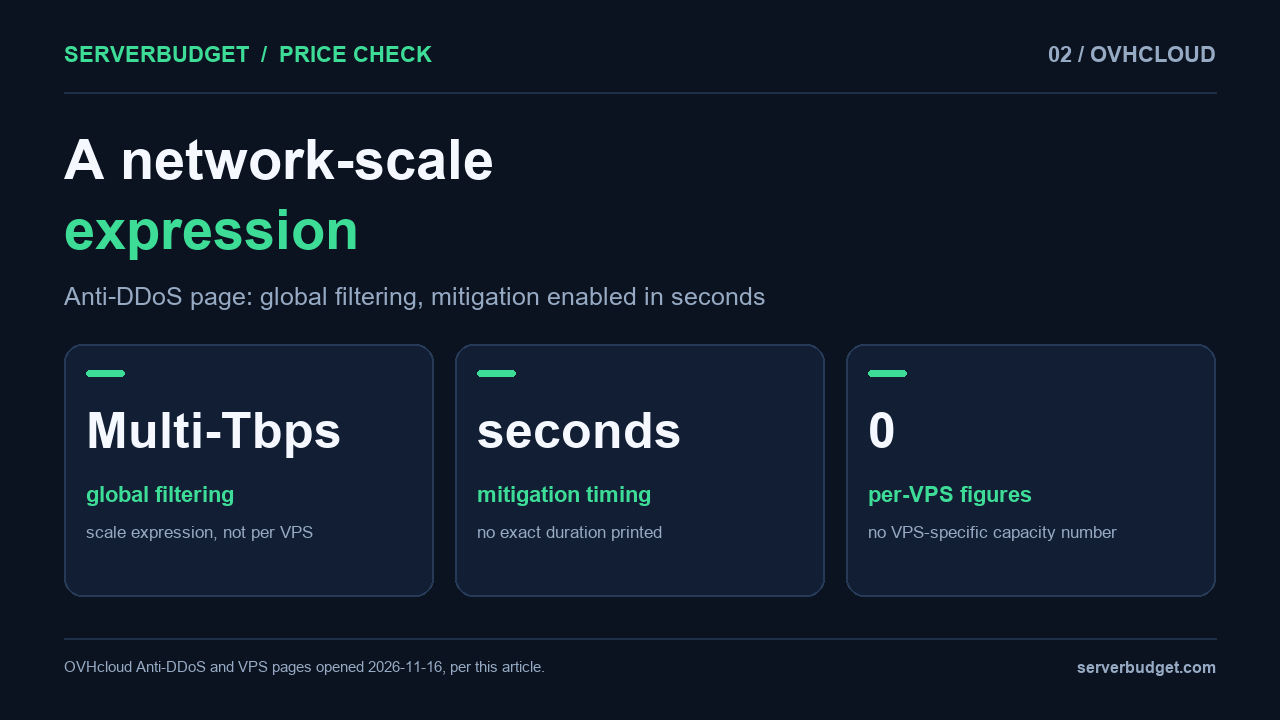
Those statements are about the provider's network and product family. None of them converts into a guaranteed number of bits per second for one VPS or one IP, a per-instance attack threshold, or an exact mitigation-time commitment. "Global filtering capacity" describes infrastructure built for many customers at once; a buyer needs to know what is committed to the single resource being purchased. No conversion between those two scopes is justified by the page, so this article does not perform one. [S1][S2]
DigitalOcean: resource scope and an over-capacity answer, still no ceiling
The page is explicit about what it covers: Droplets, Kubernetes, Managed Databases, Load Balancers and assigned Reserved IPs across its data centers. It calls the service free, built-in, always-on and automatic, identifies network layers 3 and 4, and lists volumetric and protocol-layer attack examples. Those are scope statements, not capacity figures. [S3]
One detail changed between an earlier check of the same topic and the page read on 2026-11-16. The FAQ question asking what happens when traffic exceeds mitigation capacity now has a visible answer: once the attack volume overwhelms what the provider can handle, the IP is blackholed, all incoming traffic including legitimate traffic is dropped until the traffic subsides, and the account owner is then notified. An earlier internal pre-check recorded that question as unanswered. Per the rule that a page must be re-opened on the day of publication, today's reading is the one used here; the earlier record is not carried forward as a fact. The answer describes a behavior, not a threshold: no number, unit or trigger value is attached to the point where blackholing begins. [S3]
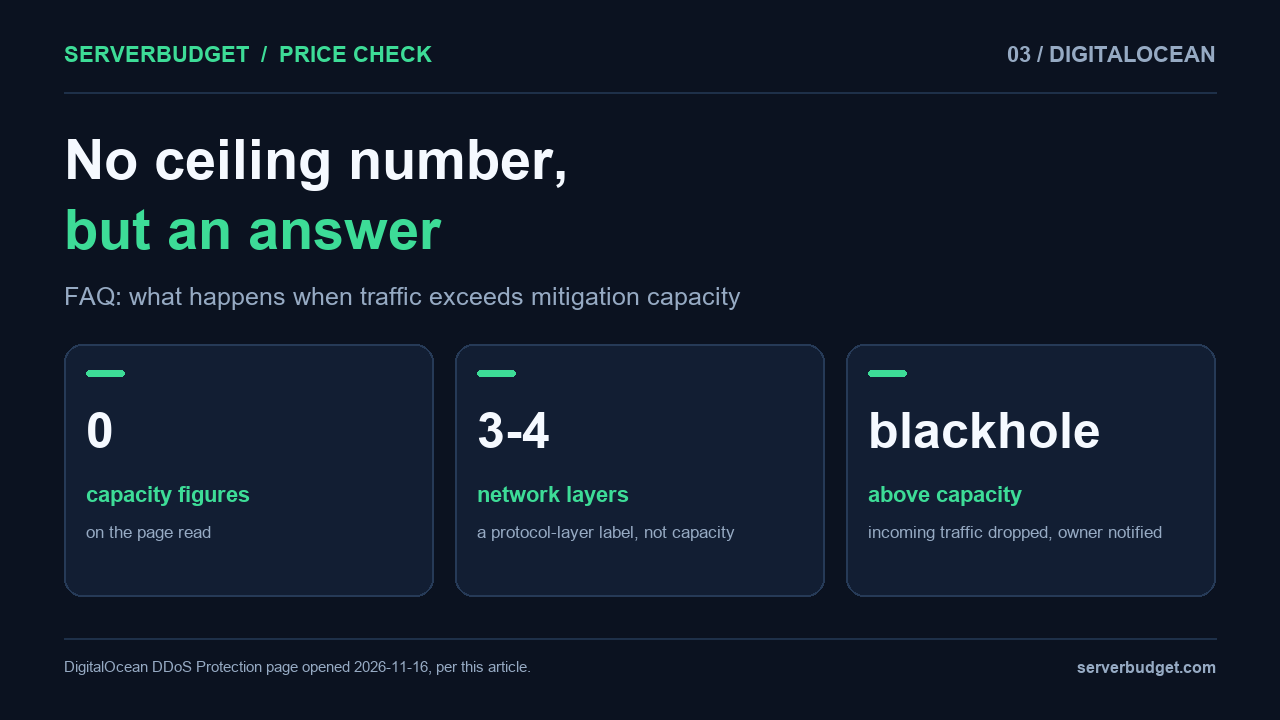
That leaves two distinct unknowns. The capacity boundary itself is unquantified, and the duration of the blackhole is described only as "until the traffic subsides". This article records both as undisclosed rather than filling them with a generic industry assumption. [S3]
Hetzner: a packet-rate example, with no Cloud-tier line in the DDoS body
The DDoS page gives one vivid number: a UDP flood at 500k pps is described as harmless for a server while a 500k SYN packet could pose a problem, to show why packet type matters more than raw rate. That rate is an illustration. It is not labeled as the product's maximum, a mitigation threshold, a guaranteed capacity or a customer-specific test, so counting it as a capacity promise would change its meaning. [S4]
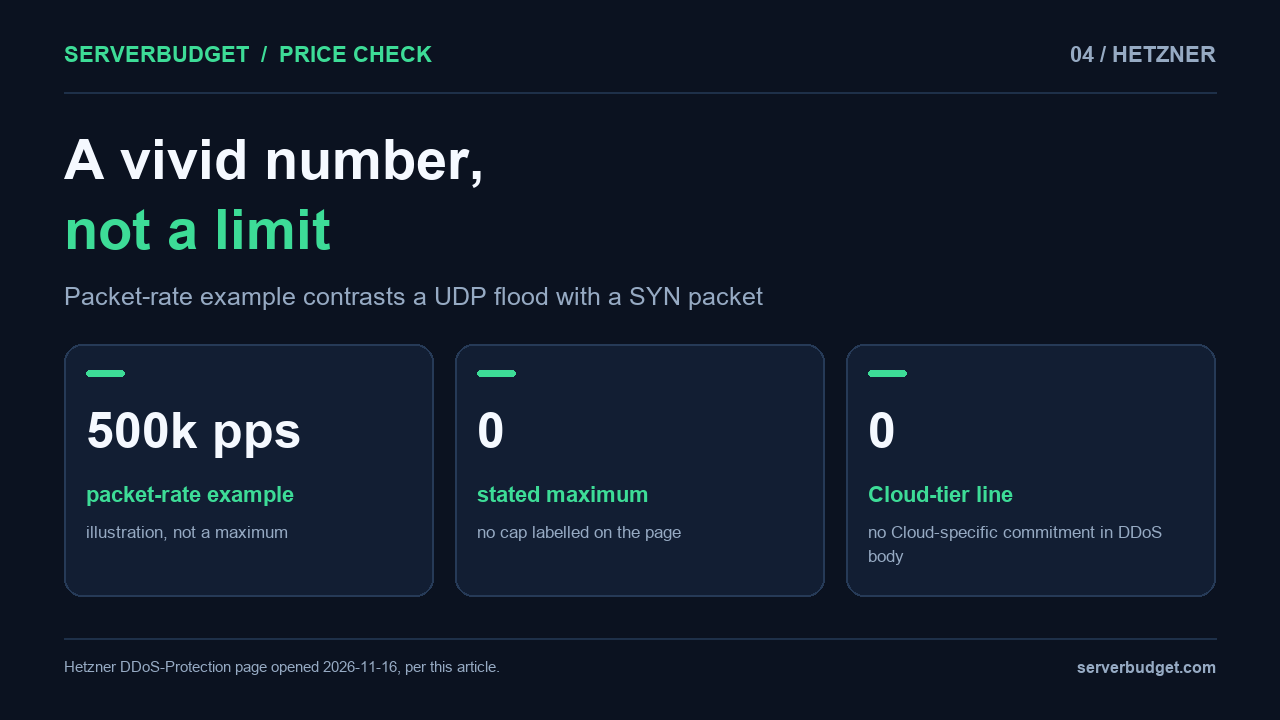
The same page describes automated recognition and dynamic filtering, says protection is free of charge and available to all customers, and says it has not caused costs or prices to increase. Its scope is company-level: web applications, websites, servers and IT infrastructure. The DDoS body read today does not name a Cloud tier or state a Cloud-server-specific commitment; the Cloud labels in the fetched page belong to navigation. That is a limit of what this page specifies, not a finding that Cloud servers are unprotected. [S4]
The on-site audit row versus OVHcloud's current official page
An earlier ServerBudget audit, published on 2026-11-11, recorded the DDoS row of its five-state table as "No published state", with the cells "Nowhere on the retrieved pages" and "Unknown from this record". The same page says plainly that not published is a finding, not a euphemism for not offered, and its FAQ repeats that the item cannot be assumed but is not definitely absent. Its plan and policy sources point to a different vendor's pages, including https://vps.us/kvm-vps/. [S5][S6]
That original source was re-opened on 2026-11-16: it returned HTTP 200 and its body contained no DDoS, denial-of-service, anti-DDoS or mitigation wording at all, so the audit's "No published state" description still matches the retrieved plan page today. This is a comparison of one vendor's disclosure record with OVHcloud's current official disclosure, not a verdict on either vendor's engineering. On one side, a budget plan page and the policy pages retrieved for that audit publish no state for DDoS protection; on the other, OVHcloud's official Anti-DDoS and VPS pages publish an included statement, a global scale expression, an attack-duration statement and a no-additional-cost statement. [S1][S2][S5][S6]
The asymmetry is about what is written, not what is deployed. The older row must not be read as "that vendor has no DDoS protection", and OVHcloud's page must not be read as "one VPS is guaranteed Multi-Tbps". Both readings would promote a disclosure statement into a technical fact that the cited pages do not supply. What the comparison does establish is verifiable: a buyer can obtain a current, specific official statement from OVHcloud today, while for the other vendor the retrieved pages still leave the item unstated. Asking that vendor for the page that states the item is the correct next step; writing "no protection" is not. [S1][S2][S5][S6]
Readability limits in this comparison set
Two further domains in this cycle's comparison set could not supply quotation-grade text today, and they are recorded item by item rather than silently dropped. Contabo's VPS landing page returned HTTP 403 with a security-check page that asks for JavaScript and cookies; no product body was retrieved. The Reddit discussion returned HTTP 403 with a network-security page requiring login or a developer token; no discussion body was retrieved. Both statuses were measured locally on 2026-11-16. [S7][S8]
In the Chinese-language working ledger these cells are written as unreadable with the same reasons; on this English page the equivalent wording is "not readable". No feature, price or policy statement about either domain is inferred for the table, and neither is used as a fourth data row in the numeric comparison. The search-result set itself was not re-run today, so nothing here is a claim about current ranking. [S7][S8]
This separation prevents two opposite mistakes. A marketing statement about protection cannot be promoted into a numeric guarantee the page never made, and an unreadable or omitted field cannot be demoted into proof that protection does not exist. Readers can ask a provider for the missing commitment, but this article does not turn an unanswered question into a guessed number.
Why the three figures cannot be ranked
The three numeric disclosures occupy different levels: a global network-capacity expression, a protocol-layer classification with a behavioral over-capacity answer, and an illustrative packet-rate contrast. Only two are capacity-shaped at all, and the packet-rate example is explicitly not a stated cap. A ranking built from these entries would manufacture a common unit and a common guarantee that the official pages do not provide. The table is useful for auditing what a buyer can verify, not for declaring which network can withstand the largest attack. That comparison rule is this article's own derivation from the scope and wording of the pages, not a provider claim. [S1][S3][S4]
A practical way to read a DDoS claim
Before treating a provider statement as a buying constraint, match the statement to the object it covers. Is the capacity attached to a global network, a product family, a server or an IP? Is a number a maximum, an example, a protocol-layer label or a traffic allowance? Does the page explain what happens when the boundary is crossed, and does it give the value of that boundary? The answers differ across these pages, and the table keeps each missing field visible instead of replacing it with a guessed norm. [S1][S3][S4]
For OVHcloud, a reader can cite a global Multi-Tbps expression, included VPS protection and an attack-duration statement, while still asking for the per-resource commitment. For DigitalOcean, a reader can cite named resource coverage and the stated blackholing behavior, while recognizing that the capacity boundary has no published number. For Hetzner, a reader can cite the packet-rate illustration and the company-level statement, while not treating either as a Cloud-tier capacity promise. These are separate evidence states, not a performance league table. [S1][S2][S3][S4]
Bottom line
The disclosure difference is measurable even when the protection itself is not: one page gives a global scale expression, one defines resource scope and an over-capacity behavior but leaves its capacity number unstated, and one gives a packet-rate example without calling it a limit or naming a Cloud tier. Two further comparison-set domains could not be read today and are reported as such. Re-opening the pages on the day of publication changed one substantive cell compared with an earlier pre-check, which is why the check date is printed in every row. The pages support a comparison of disclosure boundaries; they do not support a numeric ranking of per-VPS DDoS capacity.
Sources
- [S1] OVHcloud, Anti-DDoS: https://www.ovhcloud.com/en/security/anti-ddos/ — opened and read 2026-11-16, HTTP 200. Global capacity wording, always-on detection and mitigation timing, unmetered / no additional cost / no time limit statements, attack categories, all-products statement and per-workload tuning.
- [S2] OVHcloud, VPS: https://us.ovhcloud.com/vps/ — opened and read 2026-11-16, HTTP 200. VPS page states anti-DDoS and backup are included; no VPS-specific DDoS capacity figure on the retrieved page.
- [S3] DigitalOcean, DDoS Protection: https://www.digitalocean.com/products/ddos-protection — opened and read 2026-11-16, HTTP 200. Resource scope, layer 3-4 wording, attack examples, free / built-in / always-on wording, and the FAQ answer describing blackholing above capacity with no numeric threshold.
- [S4] Hetzner, DDoS-Protection: https://www.hetzner.com/unternehmen/ddos-schutz/ — opened and read 2026-11-16, HTTP 200. Company-level scope, attack examples, 500k pps illustration, free-of-charge and all-customers wording; the DDoS body does not identify a Cloud tier or a maximum capacity.
- [S5] ServerBudget, "What a Cheap VPS Does Not Include by Default: A Five-State Audit": https://serverbudget.com/cheap-vps-what-is-not-included — previously published 2026-11-11, re-opened 2026-11-16, HTTP 200. Its DDoS row is "No published state"; the page states this is not a euphemism for "not offered" and its FAQ says the item is not definitely absent. It is not a claim that a vendor has no protection.
- [S6] VPS US, KVM VPS plan page: https://vps.us/kvm-vps/ — opened and read 2026-11-16, HTTP 200. Re-checked as the original plan-page source cited by [S5]; its body contains no DDoS, denial-of-service, anti-DDoS or mitigation wording, so the audit's "No published state" description still matches the retrieved plan page.
- [S7] Contabo VPS landing page: https://contabo.com/en-us/vps/ — checked 2026-11-16, measured locally HTTP 403 with a JavaScript / cookies security-check page; no quotable product body, no figure used.
- [S8] Reddit discussion: https://www.reddit.com/r/SelfHosting/comments/1quq7t0/cheap_vps_hosting_best_lowcost_providers/ — checked 2026-11-16, measured locally HTTP 403 with a network-security / login-required page; no quotable discussion body, no figure used.
Frequently Asked Questions
Does "Multi-Tbps" mean one OVHcloud VPS has that capacity?
No. The page describes global filtering capacity for the provider's network. It does not state a per-VPS or per-IP guarantee. [S1][S2]
Did DigitalOcean publish what happens above mitigation capacity?
Yes, on the page read 2026-11-16 its FAQ says the IP is blackholed and all incoming traffic is dropped until the traffic subsides, then the account owner is notified. It publishes no numeric value for the capacity boundary or for how long the blackhole lasts. [S3]
Is Hetzner's 500k pps example a maximum?
The DDoS page uses it as a contrast between packet types. It does not identify it as a maximum, threshold or customer guarantee. [S4]
Does "No published state" on an older audit mean that vendor has no DDoS protection?
No. The audit page itself says that not published is a finding, not a euphemism for not offered, and its FAQ says the item is not definitely absent. Re-checking its plan-page source on 2026-11-16 still returned no DDoS wording, which confirms the disclosure gap, not the absence of a control. [S5][S6]