Managed MySQL vs Self-Hosted Databases on a Cheap VPS: Who Does the Work, and What a Plan Page Does Not Include
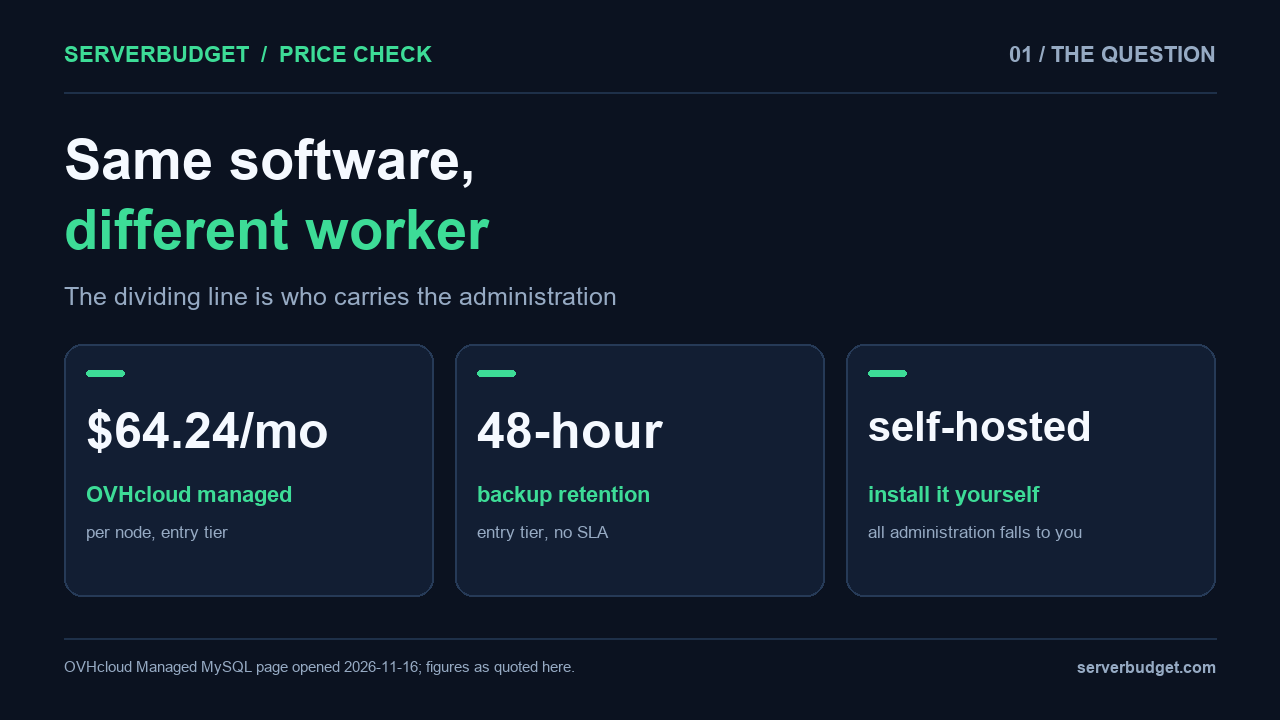
Short answer: The line between a managed MySQL service and a database you host yourself is not the software, it is who carries the administrative work. On 2026-11-16 OVHcloud's official Managed MySQL page states that the provider handles patches, backups and scalability, while the same page's own FAQ states that installing MySQL yourself on an instance or a bare metal server leaves all database administration to you; that service is priced separately per node, from $64.24 per month per node on the page read today, and its VPS page describes storing and managing databases on a VPS rather than bundling a managed database into a low-cost plan. DigitalOcean publishes a managed database product with a readable price table, and Hetzner's two catalogue pages read today list no managed database product entry at all. Two further domains in this comparison set returned HTTP 403 and are reported as not readable. A plan page listing a database service is not evidence that a cheap VPS tier includes it.
| Provider | Is the provider's managed-MySQL official page readable today | Who runs patches, backups and administration, as stated on that page | Lowest published monthly price read today | Backup retention, failover and SLA figures | Official source and check date |
|---|---|---|---|---|---|
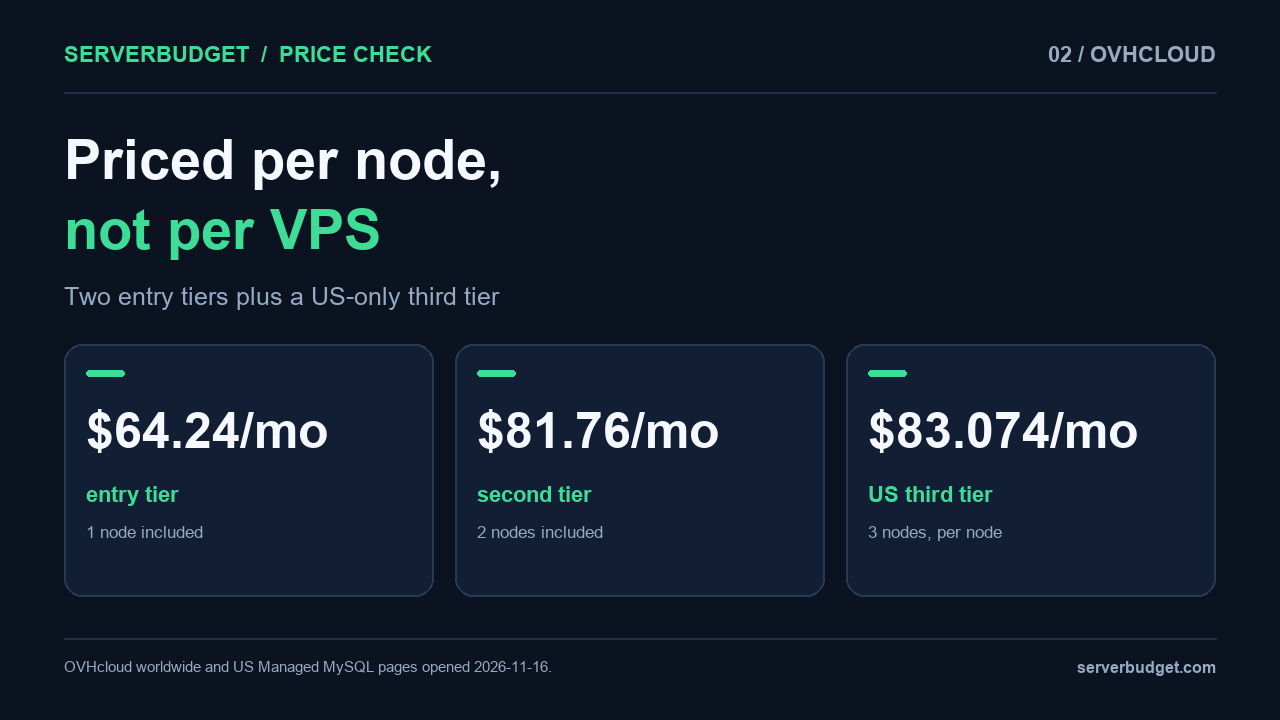
| OVHcloud | Yes. The worldwide Managed MySQL page and the US Managed MySQL page both returned HTTP 200 on 2026-11-16. [S1][S2, checked 2026-11-16, official Managed MySQL pages] | The provider states it manages patches, backups and scalability and performs the database administration tasks; its FAQ states that a customer who installs MySQL on an instance or a bare metal server must do that administration themselves and does not get the turnkey service features. [S1, checked 2026-11-16, official worldwide Managed MySQL page] | From $64.24 per month per node, 1 node included, on the entry tier; the next tier starts from $81.76 per month per node with 2 nodes included. Both figures from the worldwide page. The US page repeats $64.24 and $81.76 and adds a third tier from $83.074 per month per node. [S1][S2, checked 2026-11-16, official Managed MySQL pricing blocks] | Entry tier: 48-hour backup retention, no SLA. Second tier: 14-day backup retention, automatic failover with 1 failover and 0 downtime, 99.95% SLA on the worldwide page. A separate page-wide line states up to 99.99% SLA with multi-region 3-AZ deployments. The US page prints 99.90% SLA for its 2-node tier, 99.95% for its 3-node tier with 30-day retention. [S1][S2, checked 2026-11-16, official Managed MySQL pricing blocks] | https://www.ovhcloud.com/en/public-cloud/mysql/ [S1] and https://us.ovhcloud.com/public-cloud/mysql/ [S2]; both opened 2026-11-16, HTTP 200. |
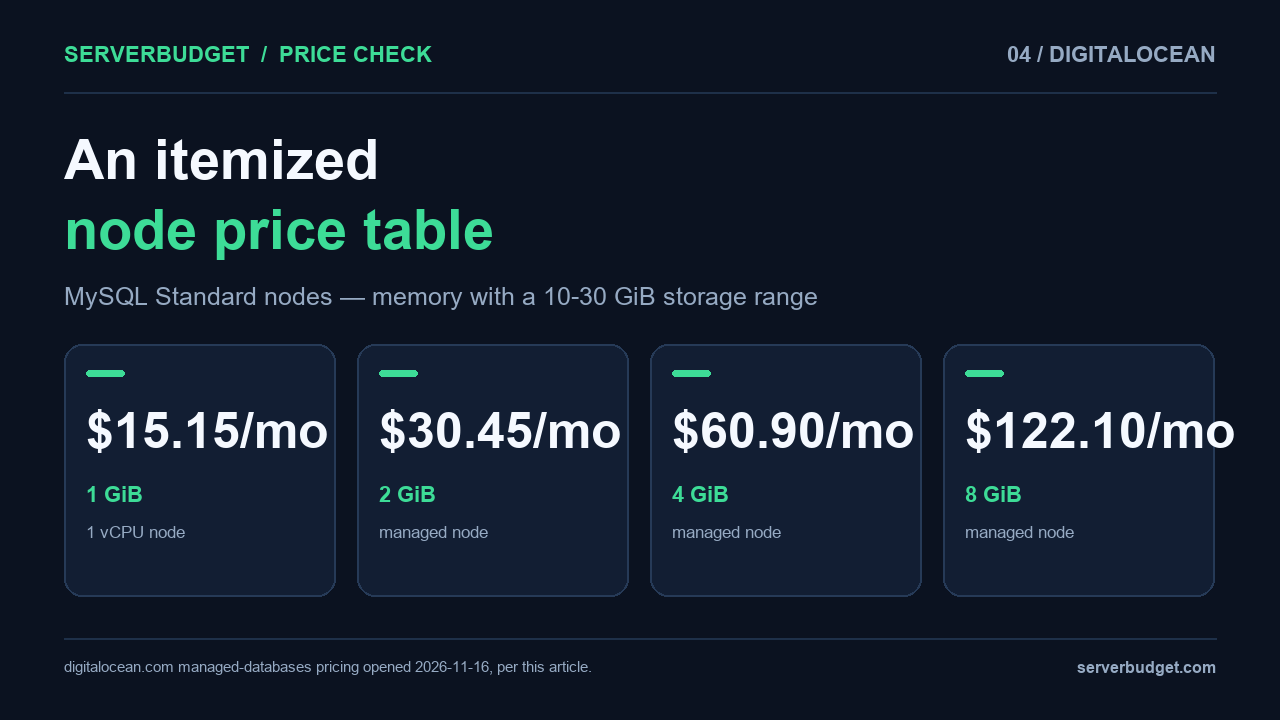
| DigitalOcean | Yes. Its managed databases product page, its MySQL product page and its managed databases pricing page all returned HTTP 200 on 2026-11-16. [S4][S5][S6, checked 2026-11-16, official product and pricing pages] | The provider states it handles setup, backups and updates, and handles the complexity of MySQL administration. [S4][S6, checked 2026-11-16, official managed databases and MySQL pages] | MySQL Standard, 1 GiB memory and 1 vCPU with a 10-30 GiB storage range: $0.02254 per hour and $15.15 per month. The same table lists 2 GiB at $30.45, 4 GiB at $60.90, 8 GiB at $122.10 and 16 GiB at $244.35 per month. [S5, checked 2026-11-16, official managed databases pricing page] | Free daily backups with restore to any point within the previous seven days, and automated failover to a standby node. The MySQL page lists Standard for data sizes below 5 TiB with failover in minutes, Advanced for up to 30 TiB with failover in seconds, and a scale-up figure of 20TB. [S4][S6, checked 2026-11-16, official managed databases and MySQL pages] | https://www.digitalocean.com/products/managed-databases [S4], https://www.digitalocean.com/pricing/managed-databases [S5], https://www.digitalocean.com/products/managed-databases-mysql [S6]; all opened 2026-11-16, HTTP 200. |
| Hetzner | Not readable as a managed-MySQL product page, checked 2026-11-16: two readable catalogue pages returned HTTP 200 but listed no managed database product entry, so there is no managed-MySQL price, retention or SLA number to quote. This records what those two pages list, not a claim that the provider offers no such service. [S7][S7b, checked 2026-11-16, official Cloud and root pages] | No administration statement readable for a managed database product on the two pages read today; the database wording there describes running databases on cloud servers, not a managed service. [S7][S7b, checked 2026-11-16, official Cloud and root pages] | Not readable, checked 2026-11-16: no managed database product or price table on the two Hetzner pages read, so no monthly figure is quoted. [S7][S7b, checked 2026-11-16, official Cloud and root pages] | Not readable, checked 2026-11-16: no retention, failover or SLA figure for a managed database product on those two pages. [S7][S7b, checked 2026-11-16, official Cloud and root pages] | https://www.hetzner.com/cloud/ [S7] and https://www.hetzner.com/ [S7b]; both opened 2026-11-16, HTTP 200, zero matches for managed database or managed MySQL in their text. |
| Contabo | Not readable, checked 2026-11-16: measured locally HTTP 403, a security-check page requiring JavaScript and cookies, no product body retrieved. No figure is used. [U1, checked 2026-11-16, measured locally HTTP 403] | Not readable, checked 2026-11-16: same HTTP 403 challenge, no administration statement obtainable. No claim is made about what this provider does or does not offer. [U1, checked 2026-11-16, measured locally HTTP 403] | Not readable, checked 2026-11-16: same HTTP 403 challenge, no price obtainable. [U1, checked 2026-11-16, measured locally HTTP 403] | Not readable, checked 2026-11-16: same HTTP 403 challenge, no retention, failover or SLA figure obtainable. [U1, checked 2026-11-16, measured locally HTTP 403] | https://contabo.com/en-us/vps/ ; checked 2026-11-16, HTTP 403 (measured locally), no quotable body. |
| Not readable, checked 2026-11-16: measured locally HTTP 403, a network-security page requiring login, no discussion body retrieved. No figure is used. [U2, checked 2026-11-16, measured locally HTTP 403] | Not readable, checked 2026-11-16: same HTTP 403 login wall, no administration statement obtainable. [U2, checked 2026-11-16, measured locally HTTP 403] | Not readable, checked 2026-11-16: same HTTP 403 login wall, no price obtainable. [U2, checked 2026-11-16, measured locally HTTP 403] | Not readable, checked 2026-11-16: same HTTP 403 login wall, no retention, failover or SLA figure obtainable. [U2, checked 2026-11-16, measured locally HTTP 403] | https://www.reddit.com/r/SelfHosting/comments/1quq7t0/cheap_vps_hosting_best_lowcost_providers/ ; checked 2026-11-16, HTTP 403 (measured locally), no quotable body. |
Every figure in the table is copied from a provider's own official page opened on 2026-11-16, and every cell that could not be read is left explicitly not readable with the measured status and the reason. In the working ledger those cells are written as unreadable; on this English page the equivalent wording is "not readable". No cell is blank and no cell is filled with an estimate. The counting and grouping rules below are this article's own derived method, not a provider claim: a figure counts only when the page attaches a number to a price, a retention period, a time window, an availability percentage or a size. A qualitative phrase is kept separate from a numeric one. [S1][S2][S4][S5][S6][S7][S7b]
The responsibility split is stated by the vendor itself
OVHcloud's Managed MySQL page answers the self-hosting question directly, and it does so twice. In one FAQ the customer asks whether MySQL can be installed on a Public Cloud instance without the managed service; the answer is that this is possible, but the customer then has to carry out all the database management and administration tasks and does not receive the turnkey service features. A second FAQ about connecting the managed service to a bare metal server says that deploying MySQL software on that server yourself means deploying, managing and administering the database yourself. [S1]
Read together with the main body, which states that the provider manages patches, backups and scalability and performs the administration tasks while the customer keeps control over the data, the page draws a line that is about labour rather than licensing. On one side, a separately billed service with stated retention and availability figures. On the other, the same database engine installed by the customer with the operational work falling back to the customer. This article does not quantify that labour cost: no source read today publishes a number for hours spent on self-hosted database administration, so none is estimated. [S1]
The pricing block makes the separation visible in a second way. The entry tier is quoted from $64.24 per month per node with 1 node included, a 48-hour backup retention and no SLA; the production tier is quoted from $81.76 per month per node with 2 nodes included, 14-day retention, one failover with zero downtime and a 99.95% SLA. A separate page-wide statement gives up to 99.99% SLA for multi-region 3-AZ deployments, which is a different deployment scope from either tier and is not a per-node guarantee. The page also describes billing per use with IOPS, backups and traffic included. These are page disclosures for a specific product, not features of a low-cost VPS tier. [S1]
One product, two official pages, two different SLA figures
The US version of the same Managed MySQL product returned HTTP 200 on the same day and repeats the two entry prices, $64.24 and $81.76 per month per node with the same node counts and retention periods. It then differs in two places. Its 2-node tier prints 99.90% SLA where the worldwide page prints 99.95% for its 2-node tier, and it adds a third tier from $83.074 per month per node with 3 nodes, 30-day retention and 99.95% SLA that the worldwide page did not show in the text read today. [S1][S2]
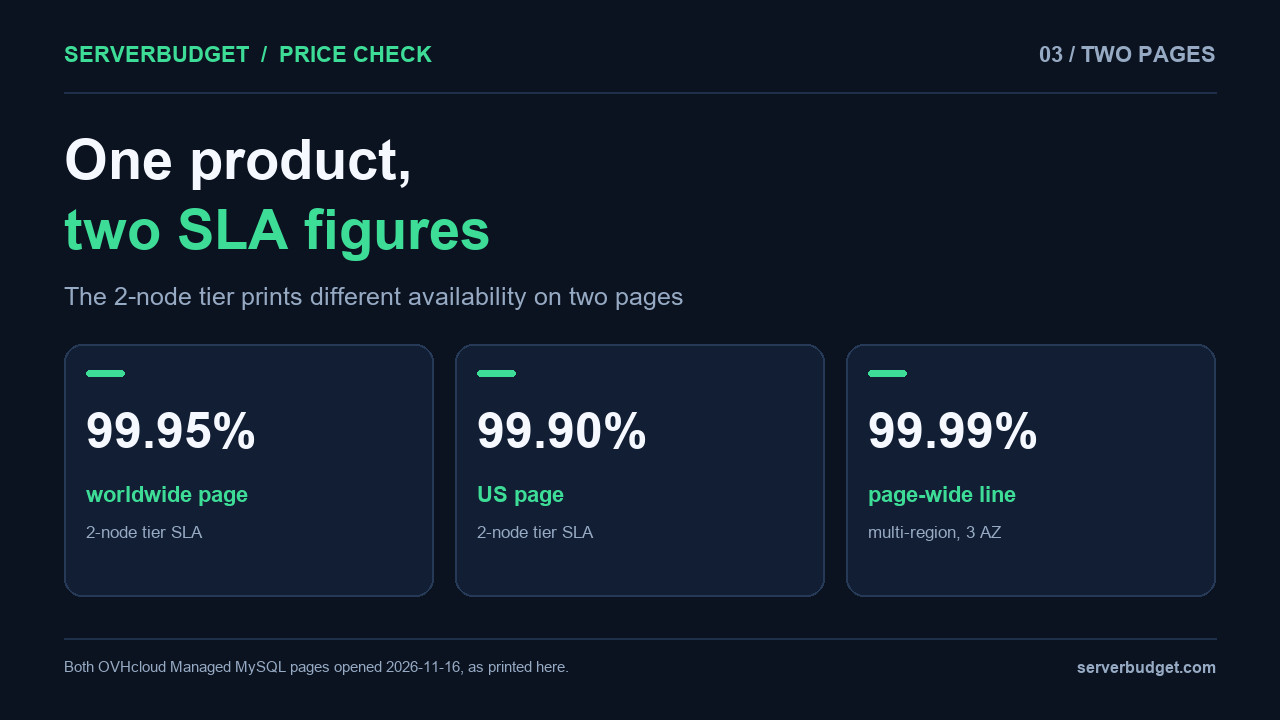
This article reports both readings rather than choosing one. The differences are recorded as differences between two official pages checked on 2026-11-16, with no inference about which figure governs a given order, which region applies, or why the two pages diverge. Guessing a reconciliation would add a claim no page supplies. A buyer comparing these numbers needs to know which localized page the order is placed on; that is a question for the vendor, not a calculation this article can perform. [S1][S2]
The practical consequence for a comparison table is simple and is applied above: a number is attached to the exact official page it came from and to that page's check date. Mixing the worldwide 99.95% with the US 99.90%, or borrowing the US third tier into the worldwide column, would produce a figure that appears on neither page as written. [S1][S2]
The on-site row versus OVHcloud's current official page
An earlier ServerBudget page, published on 2026-10-25, records a cross-vendor fact about managed databases. Its short answer recommends one provider when a managed database in the same console is wanted, and a later section states that Hetzner's catalogue has no managed database product while DigitalOcean's does, adding that self-hosting a database on a low-cost box is cheaper on paper and more expensive in calendar time. The page footer says its prices were checked against digitalocean.com and hetzner.com on 2026-10-25. [S8]
Those source pages were re-opened on 2026-11-16 rather than taken on trust. DigitalOcean's managed databases product page, its MySQL page and its managed databases pricing page all returned HTTP 200 and do publish a managed database product with an itemized price table, free daily backups with a seven-day restore window and automated failover to a standby node. That is consistent with the on-site row's description of DigitalOcean. Hetzner's Cloud page and root page also returned HTTP 200, and neither listed a managed database product entry in the text read today, which is consistent with the on-site row's description of Hetzner's catalogue as far as those two pages show. [S4][S5][S6][S7][S7b][S8]
Now put OVHcloud beside that row. Where the older page records a binary presence-or-absence fact about two vendors, OVHcloud's current official page publishes a third kind of information: an explicit allocation of administrative responsibility, a per-node price, a retention period and an availability figure. That is a real difference in what a buyer can verify today, and it is a difference in disclosure, not a verdict that one vendor's engineering is better. The older row is a statement about a catalogue on 2026-10-25; the OVHcloud figures are statements on a product page on 2026-11-16. Comparing them is legitimate only if the dates and scopes stay attached, which is why every number above carries its check date. [S1][S2][S8]
Two cautions follow from putting these sources side by side. First, "the catalogue has no managed database product" is a statement about the pages read, not a proof that the vendor has no such offering anywhere. Second, "the provider publishes a managed MySQL page with a price" is a statement about a separately billed product, not a statement that a cheap VPS plan includes it. Dropping either qualifier would turn a disclosure fact into a product claim. [S1][S7][S7b][S8]
Why a listed service is not an included service
OVHcloud's VPS page, also read on 2026-11-16, uses wording about storing and managing databases on a fast, reliable VPS, and its worldwide page carries a web-hosting section with an additional-databases item marked included. The first is an instruction to the customer to run a database on the VPS; the second belongs to a different product family. Neither is a statement that a low-cost VPS tier ships with the Managed MySQL service described on the Public Cloud page. [S1][S3][S3b]
That distinction is the whole point of this topic for a cheap-VPS buyer. A page can name a managed database, list a price for it, and describe the provider's administrative duties, while the cheap compute plan remains a machine on which the customer installs and maintains the database. The managed service is quoted per node per month; the VPS page describes a server. Treating the first as a bundled feature of the second would create a cost and a responsibility allocation that no page read today asserts. [S1][S3][S3b]
DigitalOcean's pages make the same separation in their own way. Its managed databases pricing table prices database nodes with memory, vCPU and storage ranges, while its MySQL page describes running those clusters on Droplets with shared or dedicated vCPUs. A cluster price and a Droplet price are different line items even when they appear in one console. This article does not add them together, because no page read today publishes a combined total for a named workload. [S5][S6]
What "not readable" records, and what it does not
Three kinds of unreadable cell appear in the table and they are not interchangeable. For Hetzner, the two official pages were readable at HTTP 200, but no managed database product entry appeared in them, so the price, retention and SLA cells have no product-specific number to quote. That is an absence of a listing on two named pages, not a finding about the vendor's full catalogue. For Contabo and Reddit, the pages themselves did not return product or discussion text: both measured HTTP 403 locally on 2026-11-16, one a security-check page and one a login-required network-security page. No feature, price or policy statement about either domain is inferred from those responses. [S7][S7b][U1][U2]
In the working ledger all three cases are written as unreadable with the reason and the date; the English page uses "not readable" for the same state. Neither wording means "zero". A zero would be a number, and no page read today supplies a zero for these cells. The cells stay explicitly unreadable so that a reader can ask the vendor for the missing page instead of reading a blank as a negative answer. [S7][S7b][U1][U2]
The search-result set itself was not re-run today, so nothing in this article is a claim about current ranking or about which providers appear for a given query. The comparison set is the one fixed for this cycle, and it is used only to keep the same columns across every row. [U1][U2]
A checklist for reading a managed-database claim
Before treating a provider statement as a buying constraint, separate four objects that pages often place near each other. Is the product a managed database service or a compute instance? Is the price attached to a node, a cluster or a server? Are backups, failover and an availability figure attached to the tier being priced, or to a different deployment scope on the same page? And does the page say the customer or the provider performs patching, backups and administration? The four answers differ across the pages read today, and the table keeps each field visible rather than collapsing them into a single "has managed MySQL" label. [S1][S2][S4][S5][S6]
Then check the localized version of the same product page. The two OVHcloud pages read today print different availability percentages for what is presented as the same tier structure, and one lists a third tier the other does not. A comparison that silently uses one locale for price and another for SLA would be a derived figure with no source, so the table names the page for each number. [S1][S2]
Finally, keep the on-site record dated. The older cross-vendor row is from 2026-10-25 and the official figures here are from 2026-11-16. Re-opening the underlying vendor pages is what makes the comparison current; quoting the older row as if it were today's reading would not. [S4][S5][S6][S7][S7b][S8]
Bottom line
On 2026-11-16 the verifiable difference is about responsibility and disclosure. OVHcloud publishes a managed MySQL product with a stated division of administrative work, per-node prices, retention periods and availability figures, and its own FAQ says a customer-installed database gives that administrative work back to the customer. DigitalOcean publishes a managed database product with an itemized price table and stated backup and failover behavior. Hetzner's two catalogue pages read today list no managed database product entry, and Contabo and Reddit could not be read at all, so those cells stay unreadable with the measured reason. A plan page naming a database service is not evidence that a low-cost VPS tier includes the managed service, and no page read today supports a numeric estimate of the labour saved by buying it.
Sources
- [S1] OVHcloud, Managed MySQL (worldwide): https://www.ovhcloud.com/en/public-cloud/mysql/ — opened and read 2026-11-16, HTTP 200. Responsibility allocation, the two self-installation FAQ answers, per-node prices from $64.24 and $81.76 per month, 48-hour and 14-day retention, no SLA and 99.95% SLA on the two tiers, up to 99.99% SLA for multi-region 3-AZ, billing per use, and turnkey-service wording.
- [S2] OVHcloud, Managed MySQL (US): https://us.ovhcloud.com/public-cloud/mysql/ — opened and read 2026-11-16, HTTP 200. Same two entry prices, 99.90% SLA on its 2-node tier, and a third tier from $83.074 per month per node with 3 nodes, 30-day retention and 99.95% SLA.
- [S3] OVHcloud, VPS (worldwide): https://www.ovhcloud.com/en/vps/ — opened and read 2026-11-16, HTTP 200. Wording about storing and managing databases on a VPS, and a separate web-hosting additional-databases item.
- [S3b] OVHcloud, VPS (US): https://us.ovhcloud.com/vps/ — opened and read 2026-11-16, HTTP 200. Equivalent store-and-manage wording on the US VPS page.
- [S4] DigitalOcean, Managed Databases: https://www.digitalocean.com/products/managed-databases — opened and read 2026-11-16, HTTP 200. Setup, backup and update responsibility, free daily backups with a seven-day restore window, automated failover to a standby node, and the engine list.
- [S5] DigitalOcean, Managed Databases pricing: https://www.digitalocean.com/pricing/managed-databases — opened and read 2026-11-16, HTTP 200. MySQL Standard node prices, storage ranges and the additional-storage rate.
- [S6] DigitalOcean, Managed Databases for MySQL: https://www.digitalocean.com/products/managed-databases-mysql — opened and read 2026-11-16, HTTP 200. Standard and Advanced tier descriptions, scale-up figure, failover timing wording and predictable-pricing statement.
- [S7] Hetzner, Cloud: https://www.hetzner.com/cloud/ — opened and read 2026-11-16, HTTP 200. No managed database product entry in the page text read today.
- [S7b] Hetzner, root page: https://www.hetzner.com/ — opened and read 2026-11-16, HTTP 200. No managed database product entry in the page text read today.
- [S8] ServerBudget, "Hetzner vs DigitalOcean: the numbers agree, the benchmarks don't": https://serverbudget.com/hetzner-vs-digitalocean — previously published 2026-10-25, re-opened 2026-11-16, HTTP 200. The on-site cross-vendor managed database fact and its footer naming digitalocean.com and hetzner.com with a 2026-10-25 check date.
- [U1] Contabo VPS landing page: https://contabo.com/en-us/vps/ — checked 2026-11-16, measured locally HTTP 403 with a JavaScript and cookies security-check page; no quotable product body, no figure used.
- [U2] Reddit discussion: https://www.reddit.com/r/SelfHosting/comments/1quq7t0/cheap_vps_hosting_best_lowcost_providers/ — checked 2026-11-16, measured locally HTTP 403 with a network-security and login-required page; no quotable discussion body, no figure used.
Frequently Asked Questions
Does a cheap VPS plan include OVHcloud Managed MySQL?
No page read on 2026-11-16 states that. OVHcloud's Managed MySQL is quoted per node per month as a separate Public Cloud product, while its VPS page describes storing and managing databases on a VPS. A page listing a service is not a statement that a low-cost VPS tier includes it. [S1][S3][S3b]
Who does the database administration if I install MySQL myself?
OVHcloud's Managed MySQL FAQ states that a customer who installs MySQL on a Public Cloud instance or a bare metal server must perform all database management and administration tasks and does not receive the turnkey service features. The managed service page states that the provider handles patches, backups and scalability. This article does not put a number on the labour involved, because no source read today does. [S1]
Why do two OVHcloud pages show different SLA figures?
The worldwide and US Managed MySQL pages both returned HTTP 200 on 2026-11-16, but the 2-node tier is printed as 99.95% SLA on one and 99.90% on the other, and the US page also lists a third tier. This article reports each figure against its own page and check date and does not infer why they differ or which applies to a given order. [S1][S2]
Does "no managed database product listed" mean Hetzner has no managed database?
No. It records that the two Hetzner pages read on 2026-11-16, both HTTP 200, listed no managed database product entry in their text, so no product-specific price, retention or SLA figure could be quoted. It is not a finding about the provider's full catalogue. [S7][S7b]
Why are the Contabo and Reddit cells empty of numbers?
Both pages measured HTTP 403 locally on 2026-11-16, one a security-check page and one a login-required network-security page, so no product or discussion text was retrieved. Their cells are marked not readable with the reason and check date; no figure is estimated and no feature claim is inferred. [U1][U2]
Questions people ask
are managed databases worth it
This page gives no worth-it verdict, because no source read on 2026-11-16 prices the labour of self-hosting. It reports the responsibility split and what is printed: OVHcloud Managed MySQL starts at $64.24 per month per node with patches, backups and scalability handled by the provider.
managed database vs unmanaged
The difference this page verifies is who carries the administration, not the software. OVHcloud says it handles patches, backups and scalability, while its FAQ says a customer who installs MySQL on an instance or bare-metal server does all administration. The managed service is $64.24 per month per node at entry, with 48-hour backup retention and no SLA.
what is a managed database service
On the pages read 2026-11-16, OVHcloud's Managed MySQL is a separately billed Public Cloud product with per-node prices from $64.24 per month, not a feature of a low-cost VPS tier. The VPS page instead describes storing and managing databases on a VPS yourself.
how much does database management cost
The official pages quote the managed product per node, not a generic management fee: OVHcloud from $64.24 per month per node on entry and $81.76 on the next tier, and DigitalOcean MySQL Standard at $15.15 per month for 1 GiB. No page read today puts a number on the hours of self-hosting labour.