Azure Blob Storage Pricing in 2026: Three Meters, One Bucket, Three Workloads
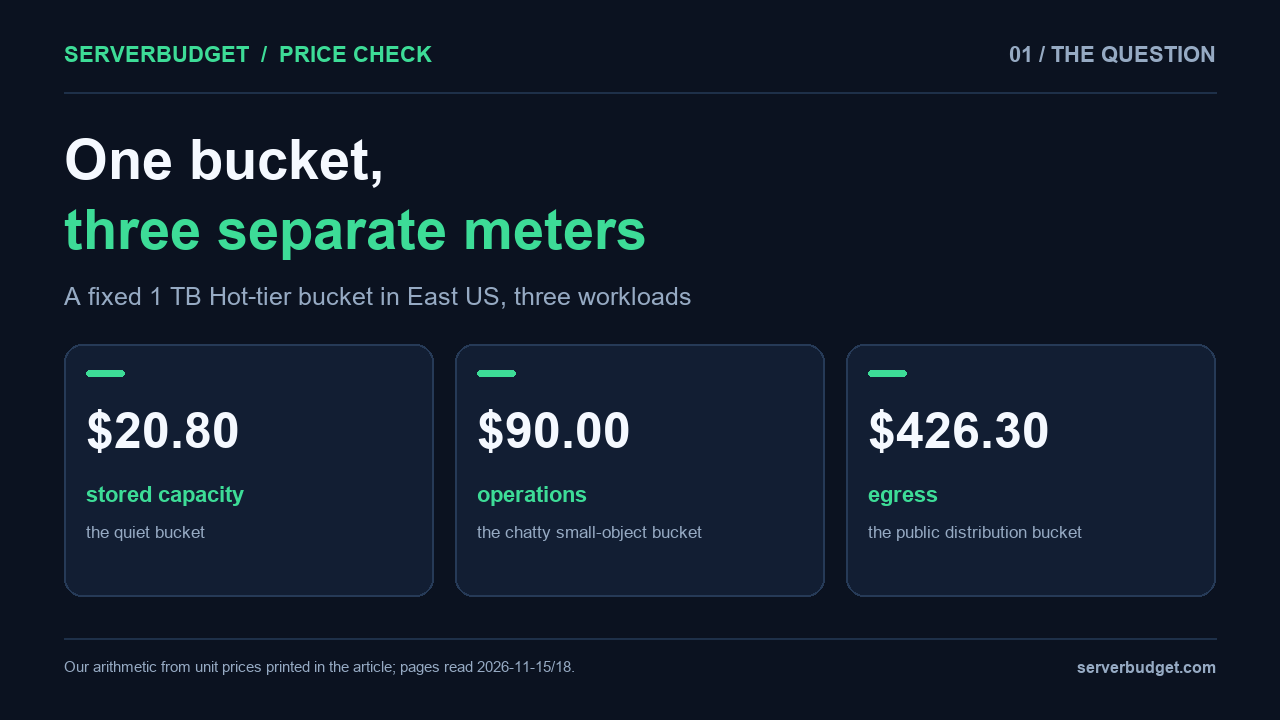
Short answer: Azure Blob Storage pricing is three separate meters, not one number per gigabyte, and for one fixed 1 TB Hot-tier bucket in East US the largest of the three changes with how that bucket is used: held quietly it is stored capacity at $20.80 against $0.54 of operations and $0.00 of egress, driven by 10,000,000 writes and 100,000,000 reads it is operations at $90.00 against $20.80 of storage and $0.00 of egress, and pushed to 5,000 GB of outbound transfer it is egress at $426.30 against $20.80 of storage and $0.54 of operations [S1][S2]. Microsoft's own pricing page states that total cost depends on the volume of data stored per month, the quantity and types of operations performed along with data transfer costs, and the redundancy option selected [S1]. We take that statement literally and do the one thing a price-per-gigabyte headline cannot do: we multiply each of the three meters separately, hold the bucket constant, and let the reader watch which meter wins under each workload [S1][S2]. The unit prices we use are $0.0208 per GB-month for Hot storage in the first 50 TB band, $0.05 per 10,000 write operations, $0.004 per 10,000 read operations, free data retrieval in the Hot tier, a free first 100 GB of monthly egress, and $0.087 per GB for the next 10 TB of egress [S1][S2]. Every one of those amounts is printed on a first-party official page that returned HTTP 200 and was directly readable in this fetch batch [S1][S2][S7]. The three workloads are fixed assumptions we set for this comparison, not measurements, not a vendor quote, not a bill, not a forecast, and not a number anyone reported to us; we label every product of our arithmetic as our arithmetic and we do not present it as a Microsoft figure [S1][S2].
Azure Blob Storage Pricing: Three Meters Billed Separately
Azure Blob Storage pricing is a set of rows with different units, and this section keeps each row in its own unit. Microsoft's Blob Storage pricing page prints a data storage table in dollars per GB per month, an operations and data transfer table priced per 10,000 operations, and a separate bandwidth page that prices Internet egress per GB [S1][S2]. We read the recommended general-purpose v2 tab with LRS redundancy, Flat Namespace, the East US region and US dollars, because those are the controls the page actually offers and the values it renders after region lock [S1][S7]. On that tab the Hot tier prints $0.0208 per GB per month for the first 50 terabyte per month band, $0.0200 for the next 450 TB and $0.0192 for storage over 500 TB [S1]. The same table prints Cool at $0.0152, Cold at $0.0036, Archive at $0.00099 and Premium at $0.15 in the first band [S1]. We quote those five tier amounts as printed cells and we do not average them, because a Cool tier row from the same page attaches a $0.10 write price and a $0.01 per GB data retrieval price while the Hot tier prints Free for data retrieval [S1]. A cheaper storage row is therefore not a cheaper bucket by itself, and we refuse to collapse the two into one headline rate [S1]. The operations table on the same tab prints write operations at $0.05 per 10,000, list and create container operations at $0.05 per 10,000, read operations at $0.004 per 10,000, and all other operations at $0.004 per 10,000 with Delete free [S1]. We keep the write price and the read price apart throughout this page, because a bucket that is written once and read a hundred million times is not priced like a bucket that is rewritten continuously [S1]. We do not treat Free as a numerical zero in every currency and every condition, because the same page attaches the word to specific rows of specific tiers [S1]. We also do not treat the free first 100 GB of egress as a permanent allowance for every region and routing choice, because the bandwidth page prints that allowance in a table with a named source continent and a named network [S2]. We state the condition next to the amount every time, and we do not silently carry a figure from one column into another [S1][S2]. We decline to call any of these rows a promotion, a contract, or a quote, and we decline to name a cheapest tier, because that ranking would depend on a workload Microsoft did not print [S1][S5]. The narrow claim we do make is about our own reading: we can reproduce the printed rows and the printed conditions, and we cannot certify an invoice.
Azure Blob Storage Cost: One Bucket Worked Three Ways
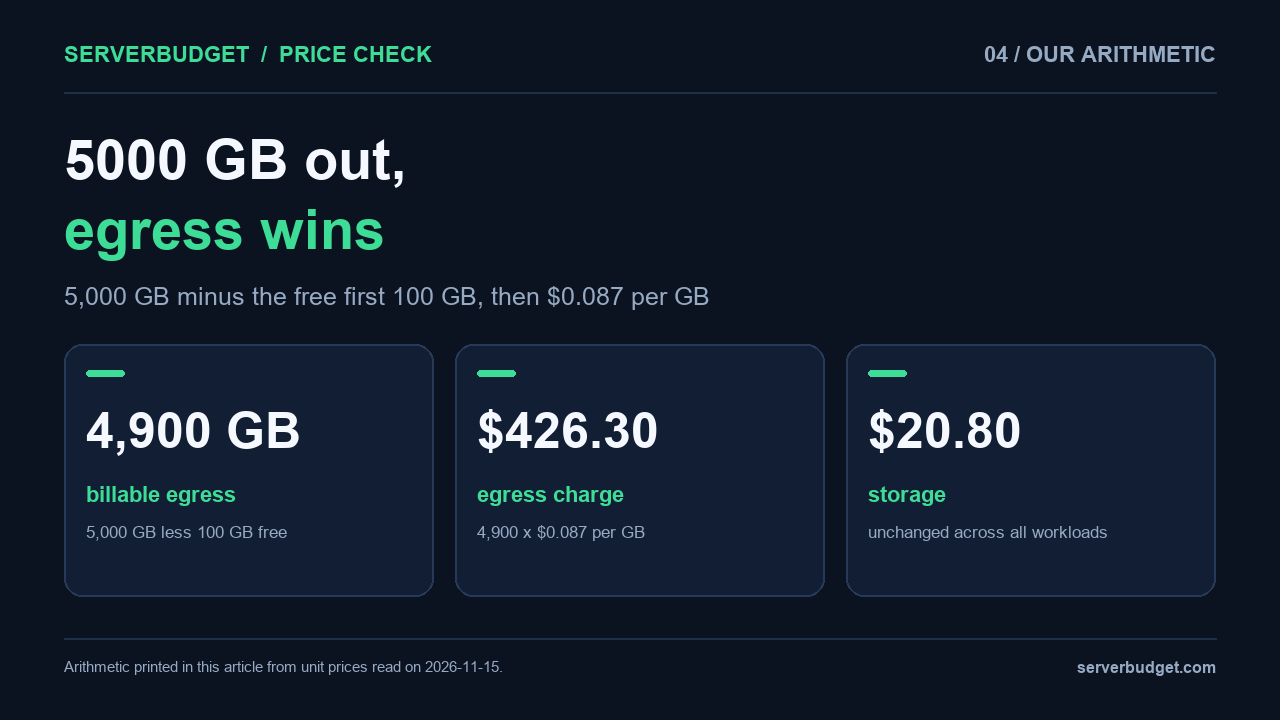
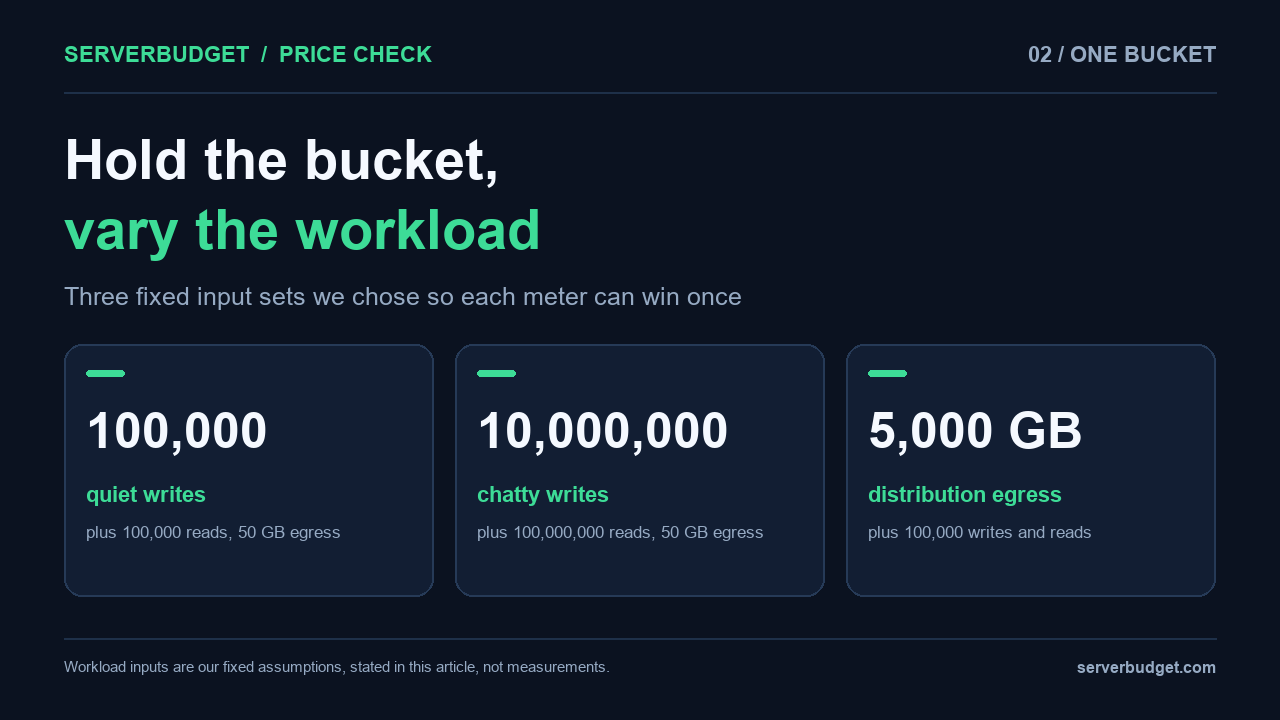
Azure Blob Storage cost is the phrase that asks for a total, and this section is the one place on this site where we print totals we computed ourselves, with the multiplication shown so that any reader can repeat it. We fix one bucket and hold it constant across all three workloads: 1,000 GB of block blob data, which the bandwidth page equates to 1 TB through its printed note that 1 TB equals 1,000 GB, held for one month on the Hot tier in East US with LRS and Flat Namespace [S1][S2]. We then vary only the operations and the outbound transfer, because those are the two meters a per-gigabyte headline hides [S1][S2]. The three workloads are fixed quantities we set for this comparison: 100,000 writes and 100,000 reads with 50 GB of egress for a quiet bucket; 10,000,000 writes and 100,000,000 reads with 50 GB of egress for a chatty small-object bucket; and 100,000 writes and 100,000 reads with 5,000 GB of egress for a public distribution bucket [S1][S2]. We state plainly that none of these six quantities is a measurement of anyone's traffic, a search volume, a bid, a competition value, a vendor example, or a forecast; they are inputs we chose so that the three meters can each be seen winning once [S1][S2]. Stored capacity is identical in all three rows: 1,000 GB multiplied by the printed $0.0208 per GB-month is $20.80 [S1]. For operations we divide the operation count by 10,000 and multiply by the printed per-10,000 price, keeping writes and reads on separate lines [S1]. For egress we apply the printed free first 100 GB per month before charging the remaining gigabytes at the printed next-10-TB rate of $0.087 per GB, and we use the North America and Europe to any destination row on the Microsoft Premium Global Network table [S2]. We do not apply a lower tier rate to any of these workloads, because 5,000 GB minus the 100 GB allowance is 4,900 GB and that volume sits inside the first metered band [S2]. We do not add tax, a reservation, a support plan, a currency conversion, or a redundancy uplift, because we did not read a comparable first-party figure for those in this batch [S1][S2][S4]. We do not claim that a real invoice would equal any total below, and we do not call any total typical [S1][S2].
| Meter as billed | Unit price as printed | Workload A: quiet bucket | Workload B: chatty bucket | Workload C: distribution bucket |
|---|---|---|---|---|
| Stored capacity | $0.0208 per GB-month [S1] | 1,000 GB = $20.80 | 1,000 GB = $20.80 | 1,000 GB = $20.80 |
| Write operations | $0.05 per 10,000 [S1] | 100,000 = $0.50 | 10,000,000 = $50.00 | 100,000 = $0.50 |
| Read operations | $0.004 per 10,000 [S1] | 100,000 = $0.04 | 100,000,000 = $40.00 | 100,000 = $0.04 |
| Operations subtotal | our arithmetic [S1] | $0.54 | $90.00 | $0.54 |
| Outbound transfer | first 100 GB free, then $0.087 per GB [S2] | 50 GB = $0.00 | 50 GB = $0.00 | 5,000 GB = $426.30 |
| Three meters added | our arithmetic [S1][S2] | $21.34 | $110.80 | $447.64 |
| Largest of the three | our comparison | stored capacity | operations | outbound transfer |
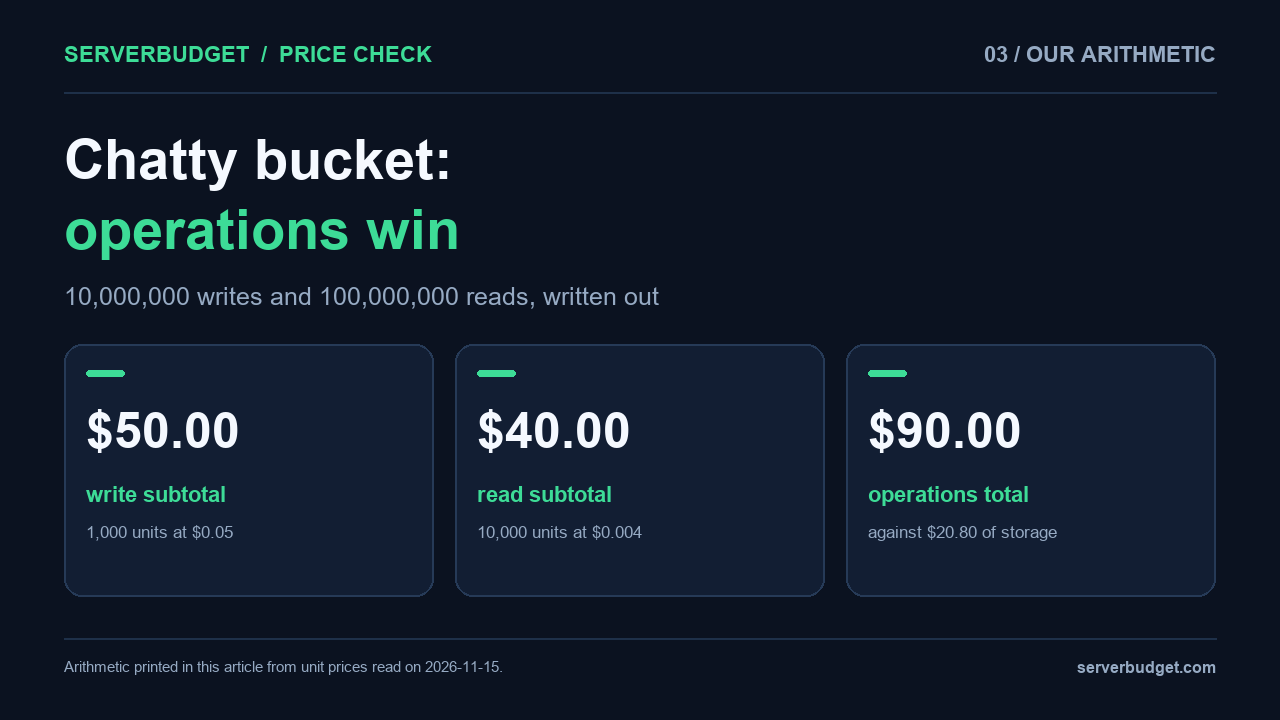
The arithmetic behind the egress cell is written out so that it can be checked: 5,000 GB of outbound transfer minus the printed free first 100 GB leaves 4,900 GB, and 4,900 multiplied by $0.087 per GB is $426.30 [S2]. The arithmetic behind the chatty operations cell is equally explicit: 10,000,000 writes divided by 10,000 is 1,000 units at $0.05, which is $50.00, and 100,000,000 reads divided by 10,000 is 10,000 units at $0.004, which is $40.00, so the operations subtotal is $90.00 [S1]. We do not add the free rows into a total as a hidden zero and we do not subtract a free allowance from a paid tier to manufacture a saving [S1][S2]. What the three rows show is a single fact that no per-gigabyte headline can show: the same bucket, in the same region, on the same tier, at the same stored volume, is dominated by a different meter in each workload [S1][S2]. We do not rank the three totals against each other as a buying recommendation, because they describe three different usage assumptions we set rather than three offers [S1][S2]. We do not extend the table to a fourth workload, because that would add a second set of assumptions with no new printed price behind it [S1][S2]. We do not convert the $0.0208 per GB-month storage row into a per-TB figure in the table, because we chose to keep the printed unit and show the multiplication instead [S1]. We do not apply the Archive tier's $0.00099 storage row to the quiet bucket, because that tier prints a $5.00 read price per 10,000 and a minimum retention period on the access tier page, which would change two meters at once [S1][S5]. Each of these refusals is a boundary we applied while writing rather than a gap we discovered afterwards.
The Three Unit Prices We Could Read for the 2026-11-16 Publish
Every amount in this section was visible in the saved first-party HTML or in the rendered price cells of the single fetch batch for this publish, and every row carries its source marker. We read the Blob Storage pricing page at HTTP 200 with 1,857,487 bytes, the bandwidth page at HTTP 200 with 192,212 bytes, and three Microsoft Learn pages at HTTP 200 with 59,562, 83,950 and 72,317 bytes respectively [S1][S2][S3][S4][S5][S7]. The storage table prints $0.0208, $0.0152, $0.0036, $0.00099 and $0.15 per GB-month for Hot, Cool, Cold, Archive and Premium in the first 50 TB band, and $0.0200 and $0.0192 for the Hot tier's next 450 TB and over 500 TB bands [S1]. The operations table prints $0.05 per 10,000 for writes and for list and create container operations, $0.004 per 10,000 for reads and for all other operations with Delete free, Free for Hot tier data retrieval per GB and Free for Hot tier data write per GB [S1]. The Cool, Cold and Archive columns on that same table print different write, read and data retrieval rows, which is why we keep the Hot column as the single condition for our worked bucket [S1][S5]. The bandwidth page prints a free first 100 GB per month followed by $0.087, $0.083, $0.07 and $0.05 per GB across the next 10 TB, next 40 TB, next 100 TB and next 350 TB bands for the North America and Europe to any destination row on the Microsoft Premium Global Network table [S2]. The same page prints a second table for routing preference via transit ISP networks with a different $0.08 starting rate, and we quote that only to say we did not mix the two tables [S2]. It also prints the note that 1 TB equals 1,000 GB, which is the conversion we used for our fixed bucket [S2]. We keep every amount in its own unit and its own condition, because a per-10,000 operation price, a per-GB-month storage price and a per-GB egress price are not one scale [S1][S2]. We did not read a comparable first-party figure for tax, reservations, support plans or an exchange rate in this batch, and we do not invent one [S1][S2][S4]. The cross-check is local: the value embedded as the East US amount in the saved pricing HTML equals the value rendered in a real browser after the region control was locked to East US, and that comparison is stored in our evidence directory with no HTTP status of its own [S7].
| Row as printed | Amount | Condition printed on the source | Official first-party source |
|---|---|---|---|
| Hot data storage, first 50 TB/month | $0.0208 per GB-month | recommended tab, LRS, Flat Namespace, East US, USD | azure.microsoft.com/pricing/details/storage/blobs/ [S1] |
| Hot data storage, next 450 TB/month | $0.0200 per GB-month | same tab and region | azure.microsoft.com/pricing/details/storage/blobs/ [S1] |
| Hot data storage, over 500 TB/month | $0.0192 per GB-month | same tab and region | azure.microsoft.com/pricing/details/storage/blobs/ [S1] |
| Cool / Cold / Archive / Premium storage, first band | $0.0152 / $0.0036 / $0.00099 / $0.15 per GB-month | tier columns of the same table | azure.microsoft.com/pricing/details/storage/blobs/ [S1] |
| Write operations | $0.05 per 10,000 | Hot column | azure.microsoft.com/pricing/details/storage/blobs/ [S1] |
| List and create container operations | $0.05 per 10,000 | Hot column | azure.microsoft.com/pricing/details/storage/blobs/ [S1] |
| Read operations | $0.004 per 10,000 | Hot column | azure.microsoft.com/pricing/details/storage/blobs/ [S1] |
| All other operations | $0.004 per 10,000 | Delete is free | azure.microsoft.com/pricing/details/storage/blobs/ [S1] |
| Data retrieval and data write | Free per GB | Hot column | azure.microsoft.com/pricing/details/storage/blobs/ [S1] |
| Internet egress, first 100 GB/month | Free | North America and Europe to any destination, Premium Global Network | azure.microsoft.com/pricing/details/bandwidth/ [S2] |
| Internet egress, next 10 TB/month | $0.087 per GB | same row | azure.microsoft.com/pricing/details/bandwidth/ [S2] |
| Internet egress, next 40 TB/month | $0.083 per GB | same row | azure.microsoft.com/pricing/details/bandwidth/ [S2] |
| Internet egress, next 100 TB/month | $0.07 per GB | same row | azure.microsoft.com/pricing/details/bandwidth/ [S2] |
| Internet egress, next 350 TB/month | $0.05 per GB | same row | azure.microsoft.com/pricing/details/bandwidth/ [S2] |
| Terabyte conversion | 1 TB = 1,000 GB | printed note below the egress table | azure.microsoft.com/pricing/details/bandwidth/ [S2] |
Azure Blob: What the Unit Is and What It Is Not
Azure Blob is the object, and this section defines that unit alone without borrowing a definition from a filesystem, a block volume or a virtual machine. Microsoft's own introduction states that Azure Blob Storage is Microsoft's object storage solution for the cloud and that Blob Storage is optimized for storing massive amounts of unstructured data, with unstructured data described as data that does not adhere to a particular data model or definition [S3]. The storage account overview states that a storage account contains all of an account's Azure Storage data objects, namely blobs, files, queues and tables, and that the account provides a unique namespace accessible over HTTP or HTTPS [S4]. We treat those two first-party statements as evidence of an addressing unit, not as evidence of performance [S3][S4]. We did not create a bucket, did not upload a blob, did not run a benchmark and did not measure latency while writing this page, so we make no claim about speed, durability or availability [S3][S4]. We decline to define a blob by a durability number, because that is a different kind of statement from a billing unit and we did not read a comparable first-party durability figure in this batch [S3][S4]. We do not use the word cloud as a feature, and we do not treat the access tier as a synonym for the object itself [S3][S5]. What the tier page does tell us is that Hot, Cool, Cold and Archive are online or offline tiers optimized for different access frequencies, that the Hot tier has the highest storage costs but the lowest access costs, and that Cool, Cold and Archive carry stated minimum retention periods of 30, 90 and 180 days respectively [S5]. We quote those as printed conditions because they explain why our worked bucket stays on one tier instead of being moved between rows to make a total look smaller [S1][S5]. We do not claim that changing a tier is instant, and we do not claim the opposite, because we did not perform one [S5]. We keep this definition separate from the arithmetic section on purpose: a sentence that says what an object is cannot also be a sentence that multiplies a price, and we did not write one that does both [S1][S3]. We also keep the redundancy option out of the arithmetic, even though the pricing page lists it as a determinant of total cost, because the page's controls offer LRS, ZRS, GRS, RA GRS, GZRS and RA GZRS and we locked one of them rather than comparing all of them [S1][S4]. A reader who needs a full redundancy comparison should start from a page that measures it; this page prints three meters on one locked condition [S1][S4].
Object Storage Service: Where This Family Stops
An object storage service is a category label, and this section says where this page stops and where the site's other page begins. The four phrases on this page are Azure Blob Storage pricing, Azure Blob Storage cost, Azure Blob and object storage service, and we hold all four on this one page with a section of its own for each [S3]. We keep this family separate from the site's existing object storage page, which was published on 2026-11-17 and covers a different set of phrases with a different set of first-party price pages [S3]. We do not merge the two families into one page, we do not retitle either page, and we do not add a seventh phrase to make them fit [S3]. We link to that page exactly once from this section and we use its own head term as the anchor text, because two independent pages should point at each other once rather than be folded together [S3]. We do not repeat that link in the takeaway box, in a table, in the FAQ or in the related list, and we do not stack keyword anchor text on it [S3]. We did not modify that already-published page while preparing this one, so its bytes on the live site are exactly the bytes it had before this publish [S7]. We state that boundary here rather than leaving it implicit, because a page about a vendor-specific meter is not a page about a category, and a reader who arrives looking for a cross-vendor comparison should be sent to the page that actually prints one [S3]. We do not claim that Azure Blob Storage is the only object storage service, and we do not claim it is certified by or endorsed by the owner of any other object storage API, because no first-party page in this batch made either statement [S3][S4]. We also do not treat the phrase object storage service as a request for a definition of object storage in general; on this page it is one of four phrases with its own section, and its section is this one [S3]. We do not add a fifth phrase, we do not split the family into two pages, and we do not put any of these four phrases on the category page as a new heading [S3][S7]. That separation is an editorial decision we applied while writing, and we record it so that no later reader has to infer it.
Why This Page Exists Separately: The Two-Family Boundary
We wrote this page as its own family page, and this section records that decision without re-opening it. The site already holds 88 pages and the most recently published one is the object storage page dated 2026-11-17 [S7]. The owner's decision for this batch is that the Azure Blob family and the object storage family do not share a page, that each stays independent, and that the already-published page is not touched [S7]. We follow that decision literally: this publish adds exactly one new page and one new sitemap entry, and it does not rewrite the earlier page, its title, its sections or its links [S7]. We do not re-run a domain-overlap precheck here, because this batch's instruction is a family decision that was already settled rather than a new measurement we were asked to take [S7]. We do not invent a union number, an intersection count or a threshold for this page, because those quantities belong to a different procedure and we did not measure them today [S7]. We do not claim that the two families were checked against 88 page slugs and titles in this batch, because we did not perform that scan today [S7]. We do state what we can verify locally: the sources manifest for this publish records the URL, effective URL, status, byte count and hash of every first-party page we read, and the region-locked browser reading is stored beside it as local evidence rather than as an HTTP source [S7]. We keep that evidence out of the price table, because a hash is not a price [S7]. We also record that we did not click any affiliate link, did not add an ad slot and did not change an existing ad slot while preparing this page [S7]. We do not treat the boundary as a claim about search engine behaviour, and we do not claim any ranking outcome [S7]. The narrow claim is about our own files: one new page, one new sitemap line, zero changes to the earlier family page [S7].
Verification Table: Every Figure, Its Source, and the Fetch Batch
Every price on this page traces to a URL that returned HTTP 200 in one fetch batch on the local machine clock date 2026-11-15 GMT+8, prepared for the 2026-11-16 publish [S1][S2][S7]. Where a first-party URL returned 404, we switched to a readable first-party page on the spot and quoted no number from the blocked one [U1]. We also probed Microsoft's retail prices JSON endpoint twice in the same batch; both probes were rate limited with HTTP 429 and returned no price item, so the endpoint supplied no figure and is not cited as a source [U1]. A storage pricing URL returned HTTP 200 but resolved to the Blob Storage pricing page and supplied no separate figure, so we record it as read without a number of its own [S6]. The rendered price cells we quote were cross-checked against the East US amounts embedded in the saved HTML after locking the region control in a real browser, and that comparison is a local file with no HTTP status [S7]. We do not reuse a status code from an earlier publish, and we do not present another reader's response as ours [S7]. Anyone repeating this check should record their own status codes and byte counts [S7].
| Figure or statement | Condition printed on the source | Official first-party source | Fetch batch | HTTP / bytes |
|---|---|---|---|---|
| $0.0208 / $0.0200 / $0.0192 per GB-month, five tier prices, operation prices, Free rows | recommended tab, LRS, Flat Namespace, East US, USD | azure.microsoft.com/pricing/details/storage/blobs/ [S1] | 2026-11-15 GMT+8 for the 2026-11-16 publish | 200 / 1857487 |
| Free first 100 GB, $0.087 / $0.083 / $0.07 / $0.05 per GB, 1 TB = 1,000 GB | North America and Europe to any destination, Premium Global Network | azure.microsoft.com/pricing/details/bandwidth/ [S2] | 2026-11-15 GMT+8 for the 2026-11-16 publish | 200 / 192212 |
| Definition of Azure Blob Storage and unstructured data | product introduction | learn.microsoft.com/azure/storage/blobs/storage-blobs-introduction [S3] | 2026-11-15 GMT+8 for the 2026-11-16 publish | 200 / 59562 |
| Storage account namespace and data object types | storage account overview | learn.microsoft.com/azure/storage/common/storage-account-overview [S4] | 2026-11-15 GMT+8 for the 2026-11-16 publish | 200 / 83950 |
| Hot, Cool, Cold and Archive tier conditions and retention periods | access tiers overview | learn.microsoft.com/azure/storage/blobs/access-tiers-overview [S5] | 2026-11-15 GMT+8 for the 2026-11-16 publish | 200 / 72317 |
| Read, no separate figure quoted | resolved to the Blob Storage pricing page | azure.microsoft.com/pricing/details/storage/ [S6] | 2026-11-15 GMT+8 for the 2026-11-16 publish | 200 / 1857487 |
| Region-locked rendered cells equal embedded East US amounts | local comparison, not an HTTP source | cdp-region-locked.json and sources-manifest-b9.json [S7] | measured locally | n/a / measured locally |
| Three official URLs not cited, no number taken from them | not readable in this batch | blobs/prices/, data-transfer/, storage-blobs-pricing [U1] | 2026-11-15 GMT+8 for the 2026-11-16 publish | 404 / 136389, 404 / 136389, 404 / 17973 |
| Retail prices endpoint probed twice, no item and no number quoted | rate limited in this batch | prices.azure.com/api/retail/prices [U1] | 2026-11-15 GMT+8 for the 2026-11-16 publish | 429 / 62, 429 / 62 |
We do not quote a number from a page we could not open, and we do not quietly replace a blocked page with a figure remembered from another day [U1]. A page that fails to load on one day is a fact about that day, not a fact about a vendor's catalogue [U1]. We do not treat the empty JSON result or the rate limited response as a zero price, because an empty item list is not a printed amount [U1]. We did not use a coupon page, a comparison widget or a third-party price list for any figure above [S1][S2]. We also record that no affiliate link was requested, clicked or added while preparing this page [S7].
What We Refuse to State
This page prints no search volume, no bid and no competition value for any of the four phrases, because those figures are not inputs to any price or any arithmetic here and we do not place them on the page. It prints no uptime measurement, no durability measurement, no support-response measurement and no benchmark result, because the readable pages supplied none that could be compared across vendors [S3][S4]. It prints no exchange rate, no tax calculation and no annual total computed from a monthly rate, because those would be derived numbers with no source line behind them [S1][S2]. It prints no winner, no score and no ordered list of providers, because a ranking built from one vendor's three meters would rank our own assumptions [S1][S2]. It prints no clip title, no account name and no claim about what a clip says, because the saved evidence for the public clip on this site contains only an identifier and a link [S7]. It prints no claim that this service is certified by or endorsed by the owner of another object storage API, and it prints no conformance result [S3]. It prints no claim that our three worked totals are Microsoft figures, quotes, bills, forecasts or typical bills, and it prints no claim that our three workloads describe a real customer [S1][S2]. It prints no durability number for a blob, no latency number for a read and no region comparison beyond the single region we locked [S1][S4]. It does not blend the definition of an object with the definition of a filesystem, a block volume or a virtual machine, and it does not turn a free allowance into a discount [S1][S2][S3]. Each refusal here is a boundary we applied while writing rather than a gap we discovered afterwards. The narrow positive claim we do make is about our own work: we read a defined batch of first-party pages, quoted their printed amounts with their printed conditions, locked one region and one tier, and multiplied three meters separately on one fixed bucket with the multiplication shown [S1][S2][S7]. That is a smaller claim than most buying guides make, and it is the one we can actually support.
Video from this site's channel
This page embeds one of the clips already public on this site's channel. It is a visual companion only: no figure, price, or claim in this article is taken from the clip, and the clip's spoken content was not transcribed or verified for this page.
If the player does not load, use the direct link: youtu.be/OnCQ3wqDYxU
Bottom Line
Azure Blob Storage bills stored capacity, operations and outbound transfer as three separate meters, and the largest of the three changes with how the same bucket is used [S1][S2]. On the printed East US Hot-tier prices, a quiet 1 TB bucket is dominated by $20.80 of storage, a chatty small-object bucket by $90.00 of operations, and a distribution bucket pushing 5,000 GB of egress by $426.30 of outbound transfer [S1][S2]. If you remember one check from this page, make it the multiplication rather than the headline: take the per-gigabyte storage row, multiply it by your own held volume, then do the same for your operation counts and your outbound gigabytes, and only then ask which meter is largest [S1][S2]. We kept each row in its own unit and its own condition, we labelled every total as our own arithmetic, and we did not turn a blocked page into a number [S1][S2][U1]. No price here came from a source we could not open, and no unreadable source was quietly replaced by a guess [U1]. We stated every boundary we applied, including the ones that made this page less tidy.
Frequently Asked Questions
Is Azure Blob Storage pricing just one price per gigabyte?
No, the official pricing page prints a storage row in dollars per GB-month, an operations row per 10,000 operations and a separate bandwidth page for egress per GB, so a single per-gigabyte figure cannot stand in for a bill. [S1][S2]
Which of the three meters is the most expensive?
It depends on usage of the same bucket: we computed stored capacity as the largest meter for a quiet 1 TB bucket at $20.80, operations as the largest for a chatty bucket at $90.00, and outbound transfer as the largest for a distribution bucket at $426.30. [S1][S2]
Are the totals on this page Microsoft quotes?
No, they are our own arithmetic on printed unit prices and on fixed workloads we set for this comparison, and we do not present them as quotes, bills, forecasts or measurements of any customer. [S1][S2]
Does the first 100 GB of free egress apply to every workload on this page?
The bandwidth page prints a free first 100 GB per month on a named source continent and network, so our quiet and chatty workloads fall inside it and our distribution workload is charged on the remaining 4,900 GB. [S2]
Which pages supplied the prices on this page?
Two first-party official pricing pages supplied every unit price, three Microsoft Learn pages supplied the definitions and tier conditions, one URL resolved to the pricing page without a separate figure, three official URLs returned 404 and two retail API probes were rate limited; none of the blocked responses supplied a number. [S1][S2][S3][S4][S5][S6][U1]
Questions people ask
does azure blob storage cost money
Yes — Azure Blob Storage bills three separate meters, and only a few rows are free. On the East US Hot tier that is $0.0208 per GB-month for storage, $0.05 per 10,000 writes, $0.004 per 10,000 reads, and the first 100 GB of egress free. Our fixed 1 TB bucket totals $21.34 quiet, $110.80 chatty and $447.64 pushing 5,000 GB of egress, all our own arithmetic on printed unit prices.
how much does azure cloud storage cost
It depends which meter dominates: our three fixed workloads on one 1 TB Hot-tier bucket total $21.34 quiet, $110.80 chatty and $447.64 distributing 5,000 GB of egress. Storage is $20.80 in all three; the difference is operations of $0.54 or $90.00 and outbound transfer of $0.00 or $426.30. Those totals are our arithmetic, not Microsoft quotes.
does azure blob storage have free tier
The page reads conditional free rows, not a blanket free tier: Hot-tier data retrieval is printed Free, Delete operations are free, and the first 100 GB of monthly egress is free on a named continent and network. We do not treat Free as a numerical zero in every currency or condition, and we do not call any tier permanently free.
how much does azure storage account cost
This page cannot give a storage-account total, because the official pages we read price meters, not the account itself. What we can quote is $0.0208 per GB-month for Hot storage, $0.05 per 10,000 writes, $0.004 per 10,000 reads, and $0.087 per GB of egress after the free first 100 GB; a bill needs your own volumes.