Object Storage in 2026: Five Official Price Pages, Four Meters, and What We Could Read
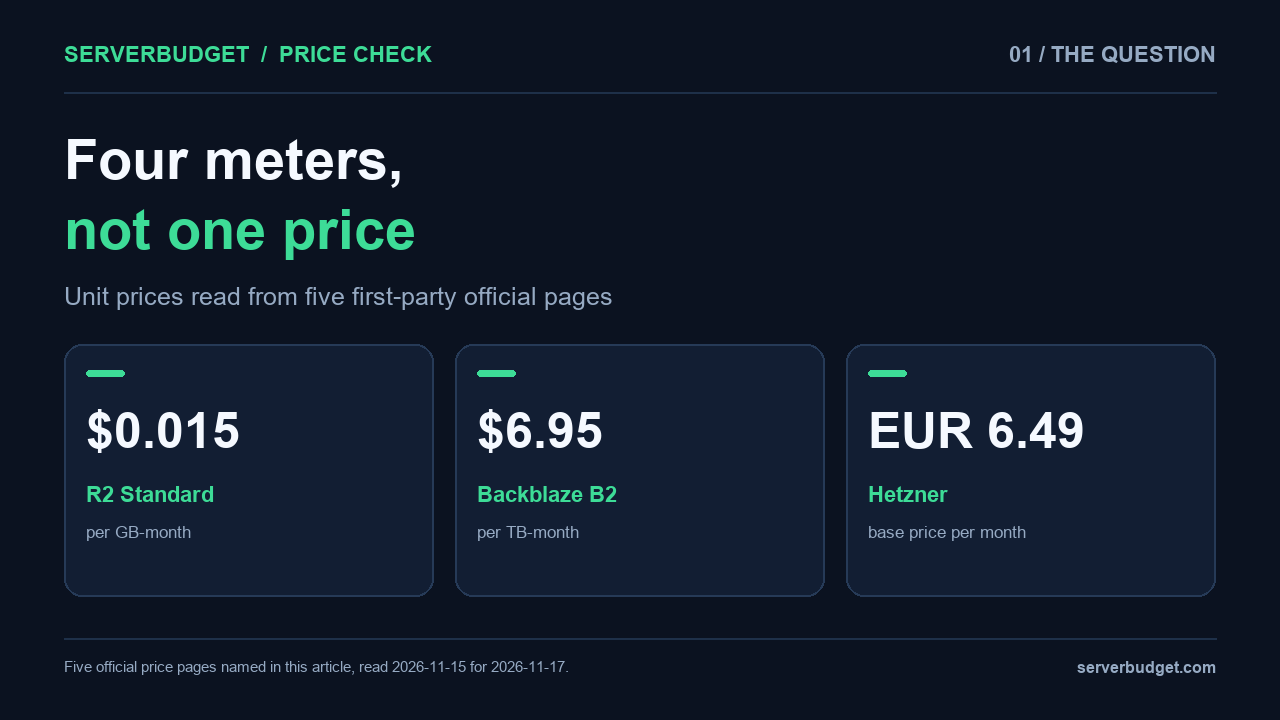
Short answer: Object storage keeps data as objects addressed by a bucket and a key rather than as files in a directory tree, and on the 2026-11-17 publish we could read unit prices from five first-party official pages: Cloudflare R2 prints $0.015 per GB-month for Standard storage and $0.01 per GB-month for Infrequent Access [S1], Backblaze B2 prints $6.95 per TB per month [S2], Hetzner prints a base price of €6.49 per month including 1 TB of storage and 1 TB of egress [S3], IDrive e2 prints a ladder of annual amounts [S4], and Storj prints $7 per TB for Standard monthly storage [S5]. Those five amounts are not one scale, and we do not merge them into a single cheapest-provider verdict. The reason is that an object store bills four separate meters: stored volume, requests, retrieval or processing, and outbound transfer [S1][S3][S5]. Two of the readable pages price egress as free or free up to an allowance, and two price it as a metered line, so a storage-only number cannot stand in for a bill [S1][S2][S3][S5]. We wrote this page because the family precheck was settled the same way it is settled for every family on this site: the six phrases produced a union of 35 domains that shared 4 with one guard page and 2 with the other, both below the threshold of 7 [S8]. Nothing on this page is an estimate, a currency conversion, a derived total, or a number carried over from an earlier day. Four other official URLs returned 403 or 404 in the same fetch batch, and we switched to a readable first-party page on the spot rather than quoting a blocked one [U1].
Object Storage: The Unit Is a Bucket and a Key, Not a Filesystem
This section defines object storage alone, and it does not define a filesystem, a block volume, or a virtual machine anywhere in the sentences below. Cloudflare's R2 pricing page is built around buckets and objects, and its worked example counts objects and GB-months rather than inodes or directory entries [S1]. Hetzner's object storage page describes a Bucket as the active unit that triggers hourly billing, and states that the included quota applies to the total storage and traffic across all Buckets in an account rather than per Bucket [S3]. Those two first-party statements are about an addressing and billing unit, and we treat them as evidence of the unit, not as evidence of performance. We did not mount any of these services, did not run a benchmark, and did not measure latency while writing this page. A vendor's own pricing page is evidence of what the vendor prints, not evidence of what a workload will cost in practice. We state that limitation once here so that no price row below has to carry it again. The exclusive claim on this page is therefore narrow: we can reproduce the printed meters and their printed conditions, and we cannot certify an invoice. We decline to say that object storage is faster or slower than any alternative, because none of the readable pages supplied a comparable first-party measurement. We also decline to define object storage by a durability number, because a durability claim and a billing unit are different kinds of statement and we did not read a comparable first-party durability figure in this batch. We keep the S3 API wording out of this section, because compatibility is a separate promise and gets its own section below. We do not treat the phrase S3 as a synonym for the whole product, and we do not treat the word cloud as a feature. A bucket name and an object key are addressing terms, and the pages we read print prices against those terms rather than against a filesystem path [S1][S3]. We repeat that boundary here deliberately, because a reader who expects to edit a file in place has crossed into a different product. No paragraph on this page blends this definition with the definition of a filesystem or a block device. That separation is an editorial rule we applied while writing rather than a gap we discovered afterwards.
Object Storage Pricing: Four Meters Billed Separately
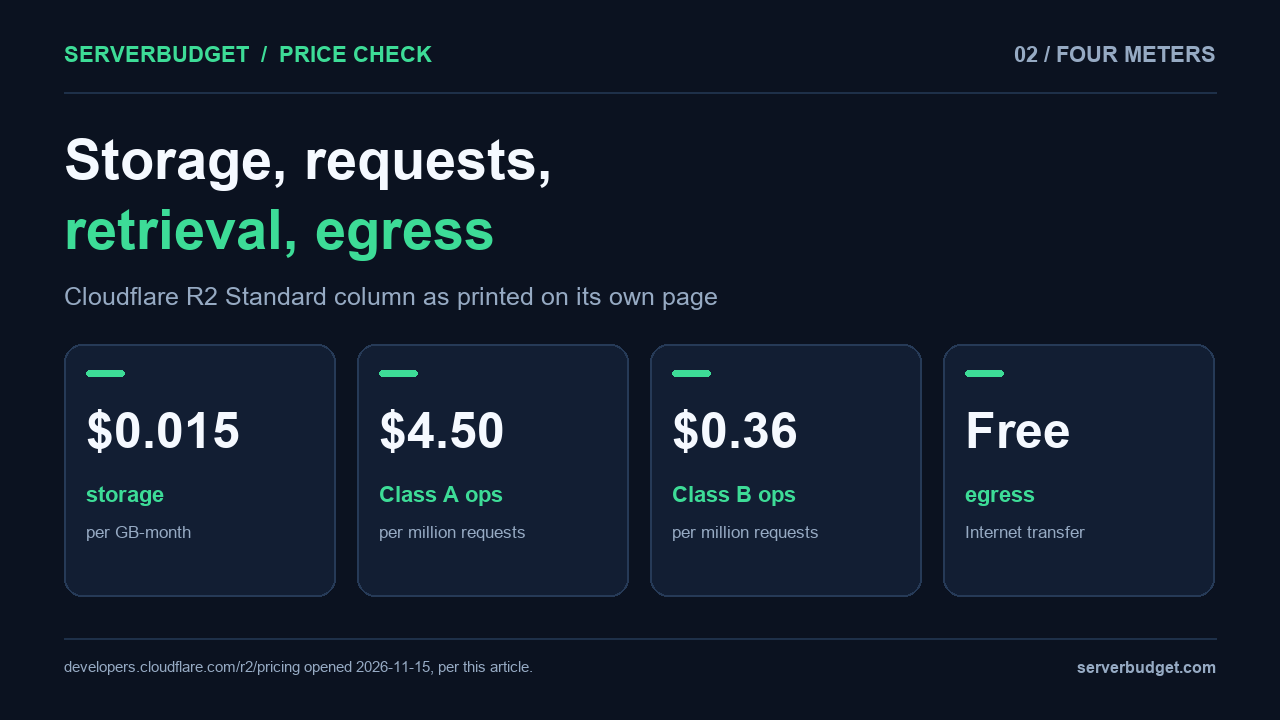
Object storage pricing is not one number, and this section lists the four meters we could actually read. Cloudflare R2 prints a storage row, a Class A Operations row, a Class B Operations row, a Data Retrieval processing row, an Egress row, and a Buckets per account row in one table [S1]. Its Standard column prints $0.015 per GB-month for storage, $4.50 per million requests for Class A operations, $0.36 per million requests for Class B operations, None for data retrieval processing, and Free for egress to the Internet [S1]. Its Infrequent Access column prints $0.01 per GB-month, $9.00 per million Class A requests, $0.90 per million Class B requests, $0.01 per GB for data retrieval processing, and Free for egress [S1]. The same page prints that the first 100,000 buckets are included and that each additional bucket is $0.10 per month, and it states there are no charges for egress bandwidth for any storage class [S1]. Hetzner prints a different shape: a base price of €6.49 per month excluding VAT that includes 1 TB of storage, up to 744 TB-hours, and 1 TB of egress traffic, with excess storage at €0.0087 per TB-hour and excess egress traffic at €1.0000 per TB [S3]. Hetzner also states the base price is billed hourly at €0.0104 per hour, capped at €6.49 per month, and that ingress traffic, internal traffic within the eu-central network zone, and S3 API calls such as PUT and GET are free of charge [S3]. Storj prints $7 per TB for Standard monthly storage with egress at $7 per TB, and $10 per TB for Advanced license pricing with egress at $7 per TB, plus a $5 minimum monthly fee [S5]. We keep each meter in its own row and its own unit, because a per-million-request amount and a per-GB-month amount are not commensurable. We do not add a request fee to a storage fee to produce a monthly bill, because no readable page prints that composite for a workload we can verify. We do not average the two egress figures from Storj, and we do not turn Hetzner's included 1 TB into a per-GB rate [S3][S5]. A derived per-gigabyte number would be our invention, not a printed figure, and this page refuses to invent one. We also refuse to treat Free as zero in every currency, because the Cloudflare page attaches Free to a table with a free tier and a caution that the free tier applies only to Standard storage [S1]. That caution is a condition, and a condition is not a number. We quote conditions as conditions and amounts as amounts. We did not read a request price on the IDrive e2 page in this batch, and we record that as a missing cell rather than treating it as an included feature [S4]. The honest reading of object storage pricing is four meters with four different units, some of them free with conditions attached.
S3 Compatible Storage: What Compatibility Covers
S3 compatible storage is a claim about an API, and this section keeps that claim separate from a claim about price. Backblaze describes B2 as enterprise-grade S3 compatible object storage in the description of its own pricing page [S2]. Storj states that its free trial works with S3-compatible apps and describes its Object Storage product as a drop-in replacement for AWS S3 [S5]. Hetzner's page refers to S3 API calls such as PUT and GET when it lists traffic that is free of charge [S3]. Those three statements are vendor descriptions of an interface, and we quote them as such. We did not run an S3 client against any of these services, and we did not test a migration, an ACL, a multipart upload, or a versioning operation. We therefore make no claim about which operations actually behave identically. Compatibility is a direction of intent printed by a vendor, not a conformance certificate we hold. We do not convert a compatibility statement into a promise that a bill will match another vendor's bill, because the same three pages print different storage and egress meters [S2][S3][S5]. We also do not treat the word S3 in a query as a request for AWS pricing, because the AWS page we read in this batch did not expose a readable unit price in its rendered text and we quote no amount from it [S6]. We record that page as read but not supplying a figure, and we do not fill its empty cells from memory. A reader who needs a strict feature-by-feature compatibility matrix should start from a page that measures API behaviour; this page measures printed prices and printed conditions. We keep that boundary explicit because a keyword that names a protocol family is not a keyword that names a vendor. We do not use the AWS brand as a synonym for object storage in any sentence on this page. We do not claim that any of these vendors is certified by anyone, and we do not claim the opposite. We state only what the three pages print, and we attach the marker to each. That is a smaller claim than a compatibility guide makes, and it is the one we can support.
Cloud Object Storage: Where Egress Stops Being Free
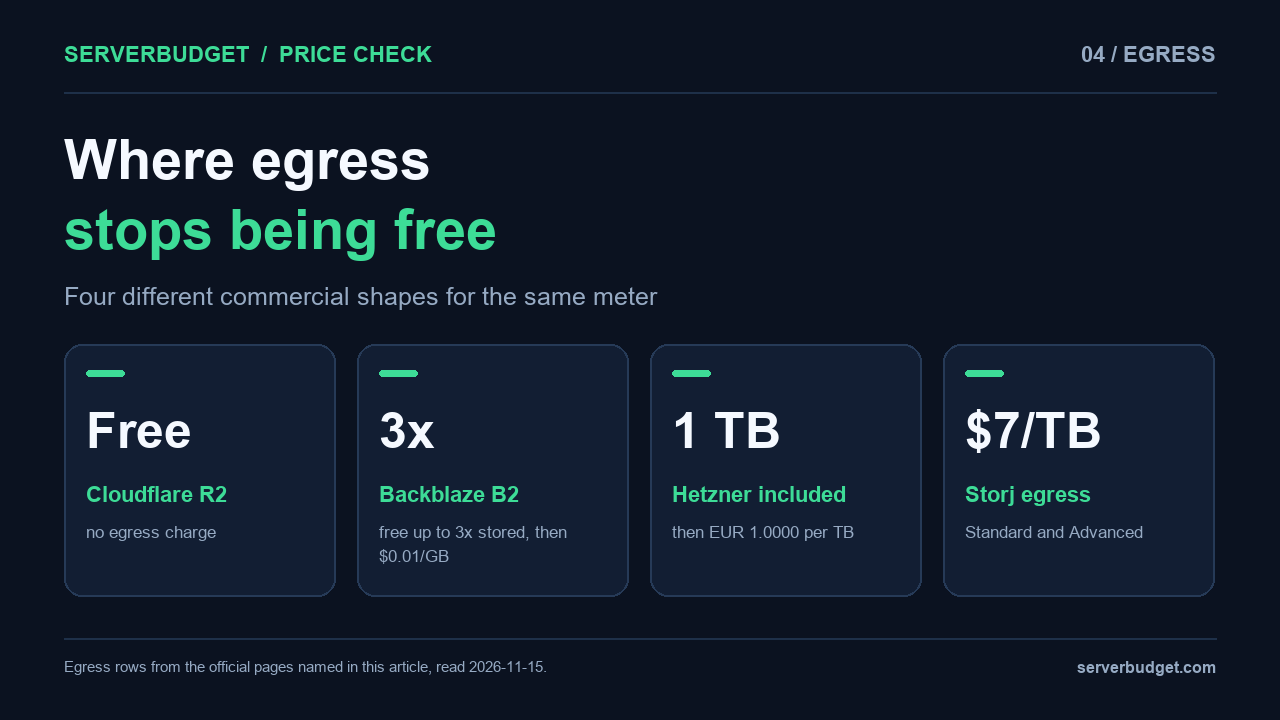
Cloud object storage is the same product with a delivery qualifier attached, and this section is about outbound transfer only. Cloudflare R2 states that there are no charges for egress bandwidth for any storage class and prints Free in the egress row of both columns [S1]. Backblaze states that free egress is available up to 3x of average monthly data stored, and that additional egress beyond that allowance is $0.01 per GB [S2]. Hetzner includes 1 TB of egress traffic in its €6.49 base price and charges €1.0000 per TB for excess egress traffic [S3]. Storj prints egress at $7 per TB on both its Standard and Advanced rows [S5]. Those four statements describe four different commercial shapes for the same meter, and we place them side by side without reducing them to one number. We do not call any of them unlimited, because two of them attach an allowance or an overage rate [S2][S3]. We do not call the R2 egress free of all conditions, because the same page carries a caution about connecting other metered services to a bucket [S1]. We do not compute the point at which a metered egress line exceeds a base price, because that would require a workload we did not measure and a currency conversion we did not read. We do not compare a euro-denominated overage with a dollar-denominated one, because no readable page in this batch supplied an exchange rate [S3][S5]. We do not use the free-tier storage allowance as a proxy for a free-tier egress allowance, because the Cloudflare page lists them as separate rows [S1]. We do not treat ingress as egress: Hetzner lists ingress traffic as free of charge and separately prices egress overage [S3]. That distinction matters because an upload-heavy workload and a download-heavy workload are not the same bill. We did not read an egress figure on the IDrive e2 page in this batch, and we leave that cell blank rather than writing zero [S4]. A blank cell is an honest result of one fetch batch, not a statement about the vendor's catalogue. We repeat that framing here because a table with a blank in it is more useful than a table with a guessed number in it. object storage
Cheap Object Storage: Which Rows Can Share a Table
Cheap object storage is a comparison word, and this section explains why we print a table instead of a winner. We can place a per-GB-month figure, a per-TB-month figure, a monthly base price with an included quota, an annual plan ladder, and a per-TB storage price in one table only if each row keeps its own unit and its own condition [S1][S2][S3][S4][S5]. We cannot rank them, because a low per-GB-month amount with a per-million-request meter and a base price that bundles a terabyte of transfer are not one scale [S1][S3]. We do not name a cheapest provider on this page. We do not compute a first-year cost from an annual plan ladder, because the IDrive e2 page prints first-year amounts beside annual amounts and we did not read the term conditions attached to each tier [S4]. We do not treat a first-year amount as a recurring amount, and we do not treat an annual amount as a monthly one [S4]. We do not discount the Storj free trial, because the page states it is free for 30 days and we did not read a renewal condition in the rendered text [S5]. We do not use Backblaze's own modelled monthly scenario as a measured bill, and we label it as a vendor-modelled comparison rather than a printed unit price [S2]. We do not quote the $15 per TB per month figure that appears in that vendor's comparison column as though it were a first-party AWS price, because we did not read that amount on an AWS page in this batch [S2][S6]. We do not claim that any of these pages is a promotion, a contract, or a quote. We do not subtract a free tier from a paid tier to produce a saving, because that arithmetic would be ours and not the vendor's [S1]. We do not turn an included quota into a discount, because Hetzner prints the quota as part of a base price rather than as a separate credit [S3]. We do not treat a $5 minimum monthly fee as a starting price, because Storj prints it as a floor attached to Standard and Advanced plan accounts [S5]. Each refusal here is a boundary we applied while writing, and each one keeps the table reproducible. A price we could not read is treated as a missing value rather than a low value. That rule is why several well-known vendors are absent from the table even though their names appear in the source manifest [U1].
S3 Storage Cost: One Worked Example We Can Reproduce
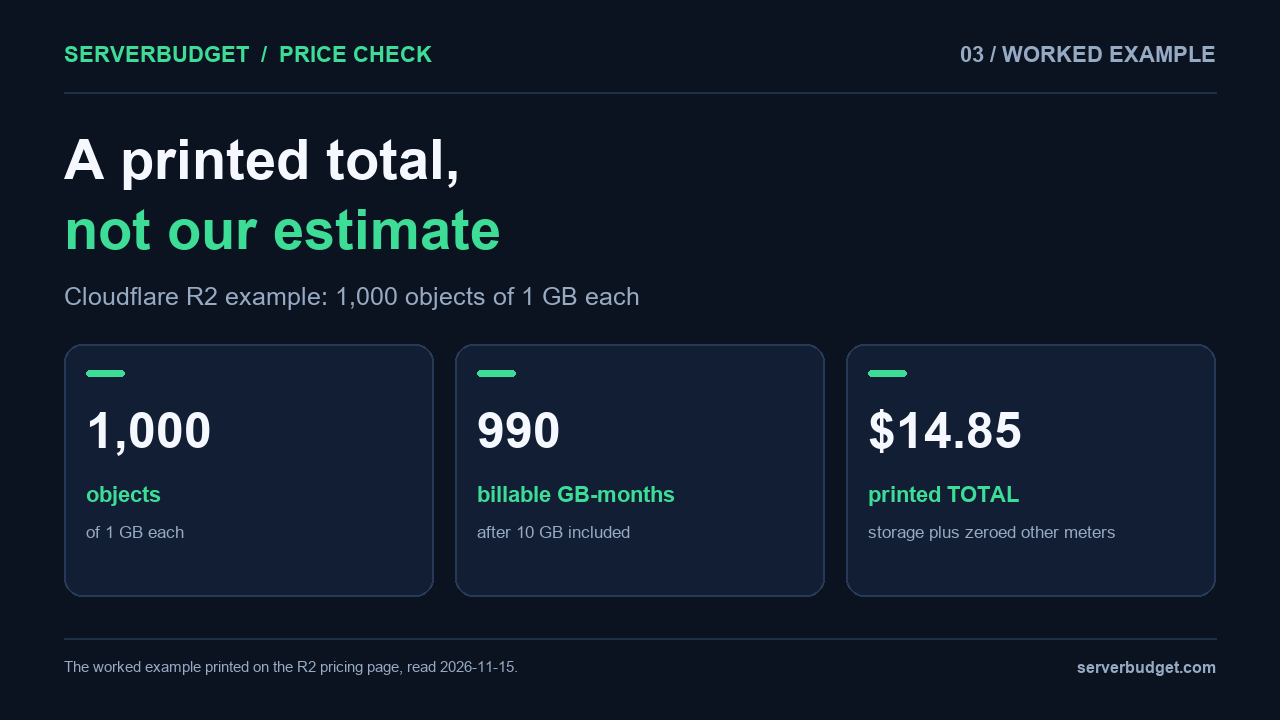
S3 storage cost is the phrase that asks for a total, and the only total we reproduce is one a first-party page prints itself. Cloudflare R2 includes a worked example for 1,000 objects of 1 GB each in its Standard storage table: it lists 1,000 GB-months of usage, 10 GB-months of included allowance, 990 GB-months billable, and a storage amount of $14.85 [S1]. The same example prints $0.00 for Class A operations, $0.00 for Class B operations, $0.00 for data retrieval, and a TOTAL of $14.85 [S1]. A second example on the same page prints $10.00 for storage, $9.00 for Class A operations, $0.90 for Class B operations, and $10.00 for data retrieval in an Infrequent Access scenario [S1]. We reproduce those printed cells as printed cells, and we do not add them into a total that the page does not print. We do not extend the example to a different object count, because that would be a multiplication we performed rather than a figure we read. We do not apply the example's allowance to another vendor's table, because the allowance belongs to one page [S1]. We do not treat the $14.85 total as a forecast for any workload, and we do not describe it as a typical bill. The R2 page also states that for Infrequent Access storage, retrieving 1.1 GB of data is billed for 2 GB, and we quote that as a printed rounding condition rather than deriving a rate from it [S1]. Backblaze prints a vendor-modelled scenario with a monthly estimate of $1,738 and a stated difference of $1,964 against a comparison column, and we record those as modelled figures belonging to that vendor rather than as readings from a competitor's price page [S2]. We do not recompute the 53 percent figure that page prints, and we do not reuse it as our own comparison [S2]. We keep vendor arithmetic labelled as vendor arithmetic. We did not read a comparable worked example on the Hetzner, IDrive e2, or Storj pages in this batch, and we do not manufacture one to fill the gap [S3][S4][S5]. The narrow positive claim here is about our own work: we found one worked example that a first-party page publishes in full, and we copied its cells with their conditions attached. We did not verify the example by running a bucket, and we do not claim that a real invoice would equal it. We state that once, here, so the table below does not have to carry a disclaimer in every row.
Object Storage Prices We Could Read for the 2026-11-17 Publish
Every amount in this section was visible in the saved first-party HTML or rendered text of the single fetch batch for this publish, and every row carries its source marker. Cloudflare R2 prints $0.015 per GB-month for Standard storage and $0.01 per GB-month for Infrequent Access storage, $4.50 and $9.00 per million Class A requests, $0.36 and $0.90 per million Class B requests, None and $0.01 per GB for data retrieval processing, Free egress in both columns, and $0.10 per additional bucket per month beyond the first 100,000 [S1]. Its free tier prints 10 GB-month per month of storage, 1 million Class A requests per month, and 10 million Class B requests per month, with a caution that the free tier applies only to Standard storage [S1]. Backblaze B2 prints a starting figure of $6.95 per TB per month, free egress up to 3x of average monthly data stored, $0.01 per GB for additional egress, and downloads at $0.01 per GB with free transfer to many CDN and compute partners [S2]. Hetzner prints a base price of €6.49 per month excluding VAT including 1 TB of storage and 1 TB of egress, hourly billing at €0.0104 per hour capped at €6.49 per month, excess storage at €0.0087 per TB-hour, and excess egress at €1.0000 per TB [S3]. IDrive e2 prints annual amounts of $59.50, $119.00, $297.50, $595.00, $1190.00, $1785.00, $2380.00, $2975.00, $5950.00 and $11900.00, with first-year amounts of $29.75, $59.50, $148.75, $297.50, $595.00, $892.50, $1190.00, $1487.50, $2975.00 and $5950.00 printed beside them [S4]. Storj prints a free trial at $0 for 30 days, Standard storage at $7 per TB with egress at $7 per TB, Advanced license pricing at $10 per TB with egress at $7 per TB, and a $5 minimum monthly fee [S5]. We keep each amount in its own currency, its own unit, and its own condition, because a per-GB-month rate, a per-TB-month rate, a VAT-exclusive monthly base price, an annual plan amount, and a per-request fee are not one scale.
| Row as printed | Amount | Condition printed on the source | Official first-party source |
|---|---|---|---|
| Cloudflare R2 Standard storage | $0.015 / GB-month | Standard column of the storage row | developers.cloudflare.com/r2/pricing/ [S1] |
| Cloudflare R2 Infrequent Access storage | $0.01 / GB-month | Infrequent Access column; retrieval fees apply | developers.cloudflare.com/r2/pricing/ [S1] |
| Cloudflare R2 Class A operations | $4.50 / $9.00 per million requests | Standard / Infrequent Access | developers.cloudflare.com/r2/pricing/ [S1] |
| Cloudflare R2 Class B operations | $0.36 / $0.90 per million requests | Standard / Infrequent Access | developers.cloudflare.com/r2/pricing/ [S1] |
| Cloudflare R2 data retrieval processing | None / $0.01 per GB | Standard / Infrequent Access | developers.cloudflare.com/r2/pricing/ [S1] |
| Cloudflare R2 egress to the Internet | Free | Both storage classes | developers.cloudflare.com/r2/pricing/ [S1] |
| Cloudflare R2 buckets | First 100,000 included, then $0.10 per bucket per month | Per-account row | developers.cloudflare.com/r2/pricing/ [S1] |
| Cloudflare R2 worked example TOTAL | $14.85 | 1,000 objects of 1 GB, Standard storage | developers.cloudflare.com/r2/pricing/ [S1] |
| Backblaze B2 storage | $6.95 / TB / mo | Starting figure on the pricing page | backblaze.com/cloud-storage/pricing [S2] |
| Backblaze B2 egress | Free up to 3x stored, then $0.01 / GB | Allowance footnote | backblaze.com/cloud-storage/pricing [S2] |
| Hetzner base price | €6.49 / month, excl. VAT | Includes 1 TB storage and 1 TB egress | hetzner.com/storage/object-storage/ [S3] |
| Hetzner hourly base | €0.0104 / hour | Capped at €6.49 / month | hetzner.com/storage/object-storage/ [S3] |
| Hetzner excess storage / egress | €0.0087 per TB-hour / €1.0000 per TB | Beyond the included quota | hetzner.com/storage/object-storage/ [S3] |
| IDrive e2 annual ladder, first four rows | $59.50, $119.00, $297.50, $595.00 per year | First-year $29.75, $59.50, $148.75, $297.50 | idrive.com/e2/pricing [S4] |
| Storj Standard storage / egress | $7 / TB / $7 / TB | Paid plan monthly storage | storj.io/pricing [S5] |
| Storj Advanced license pricing / egress | $10 / TB / $7 / TB | Paid plan license pricing | storj.io/pricing [S5] |
| Storj minimum monthly fee | $5 | Standard and Advanced plan accounts | storj.io/pricing [S5] |
We do not compute an effective monthly cost for any annual plan row, because the printed term conditions were not read in this batch [S4]. We do not convert euros to dollars, because no readable page in this batch supplied an exchange rate [S3]. We do not name a cheapest provider, and we do not produce a ranking [S1][S2][S3][S4][S5]. We do not subtract a first-year amount from an annual amount to produce a saving, because that pair is printed by one vendor for one plan ladder and we did not read the term attached to it [S4]. We do not add a request fee to a storage fee, because no first-party page prints that composite for a workload we verified [S1]. A price we could not read is treated as a missing value rather than a low value. That rule is what keeps the table reproducible. It also explains why several well-known vendors are absent from the table even though their names appear in the source manifest: their pricing URLs returned 403 or 404 in this batch [U1]. We did not replace those rows with numbers remembered from another day. We did not use a coupon page, a comparison widget, or a third-party price list for any figure above. Every row here traces to a page that publishes its own amount.
Why This Page Exists Separately: The Union Precheck
Before writing, the family precheck was run in two independent snapshots on the same day, and this publish does not re-decide it. The six family terms were each searched once on Google US Web results with gl=us and udm=14, the top ten organic result domains were reduced to registrable domains, and their union contained 35 distinct domains [S8]. That union shared 4 domains with the top-ten set of cloud vps server and 2 with the top-ten set of linux vps server, and both numbers are below the threshold of 7 [S8]. The shared domains on the first side were amazon.com, digitalocean.com, google.com and reddit.com, and on the second side digitalocean.com and reddit.com [S8]. Both guard pages carry no meta keywords, so their head terms come from their titles and h1 headings [S8]. Two independent rounds gave identical judgement quantities: the same 35-domain union, the same two intersection sizes, the same shared-domain sets, and the same decision [S8]. The precheck file is local evidence rather than an HTTP source, so its row in the verification table below carries no status code [S8]. We use the six-term reading here because those are the six terms this page contains. This page therefore holds object storage, object storage pricing, s3 compatible storage, cloud object storage, cheap object storage and s3 storage cost as one family on one page, with a section of its own for each phrase. No seventh phrase was added, and the family was not split into two pages. We did not re-fetch a SERP, re-count a domain, or re-decide the guard question while writing this page. Repeating a settled measurement would add a second number set with no new information, which this page refuses to do. We also record that the two phrases the site already covers as dedicated pages were dropped whole from the new-family list rather than retitled: bare metal server collides with /dedicated-server-hosting, and additional ip collides with /vps-price-extra-ipv4 [S8]. We did not open a second page for either of them, because a synonym title does not remove a topic collision.
Verification Table: Every Figure, Its Source, and the Fetch Batch
| Figure or statement | Condition printed on the source | Official first-party source | Fetch batch | HTTP / bytes |
|---|---|---|---|---|
| $0.015 / $0.01 per GB-month; $4.50 / $9.00 and $0.36 / $0.90 per million; Free egress; $14.85 example | R2 Standard / Infrequent Access table and worked example | developers.cloudflare.com/r2/pricing/ [S1] | 2026-11-15 GMT+8 for the 2026-11-17 publish | 200 / 143175 |
| $6.95 per TB per month; free egress up to 3x; $0.01 per GB beyond | B2 pricing page description and egress footnote | backblaze.com/cloud-storage/pricing [S2] | 2026-11-15 GMT+8 for the 2026-11-17 publish | 200 / 244253 |
| €6.49 / month; €0.0104 / hour; €0.0087 per TB-hour; €1.0000 per TB | Base price, hourly cap, and excess-quota FAQ | hetzner.com/storage/object-storage/ [S3] | 2026-11-15 GMT+8 for the 2026-11-17 publish | 200 / 141351 |
| Ten annual amounts and ten first-year amounts | Printed plan ladder | idrive.com/e2/pricing [S4] | 2026-11-15 GMT+8 for the 2026-11-17 publish | 200 / 156326 |
| Free trial $0 for 30 days; $7 / TB Standard; $10 / TB Advanced; egress $7 / TB; $5 minimum | Free trial and paid plan rows | storj.io/pricing [S5] | 2026-11-15 GMT+8 for the 2026-11-17 publish | 200 / 26663 |
| Read but no unit price quoted | Rendered text carried a Free Tier credit line only | aws.amazon.com/s3/pricing/ [S6] | 2026-11-15 GMT+8 for the 2026-11-17 publish | 200 / 519531 |
| Read but no unit price quoted | Rendered text carried Public Cloud credit lines only | us.ovhcloud.com/public-cloud/object-storage/ [S7] | 2026-11-15 GMT+8 for the 2026-11-17 publish | 200 / 444099 |
| Union of 35 domains; 4 shared with one guard and 2 with the other; two identical rounds | Our own precheck evidence, measured on this machine | guard-precheck.json [S8] | measured locally | n/a / measured locally |
| Four official URLs not cited and not substituted with remembered numbers | Not readable in this batch | digitalocean.com/pricing/spaces, linode.com/pricing/, wasabi.com/cloud-storage-pricing/pricing, us.ovhcloud.com/public-cloud/object-storage/prices/ [U1] | 2026-11-15 GMT+8 for the 2026-11-17 publish | 404 / 127612, 403 / 2981, 404 / 146948, 404 / 303323 |
All status codes and byte counts in the last column come from one fetch batch saved locally on the machine clock date 2026-11-15 GMT+8, prepared for the 2026-11-17 publish, and they describe those saved responses rather than any other reader's response. The sources-manifest-b8.json file in the evidence directory holds the URL, effective URL, status, byte count and sha256 for every one of those pages, including the readable ones and the blocked ones. When a page returned 403 or 404 we switched to a readable first-party page on the spot, choosing the replacement from the same batch of official pages rather than guessing a URL [U1]. No number on this page came from a blocked page, and no blocked page was quietly replaced by a figure from memory. A page that fails to load on one day is a fact about that day, not a fact about the vendor's prices. Anyone repeating this check should record their own status codes instead of reusing ours. We also record that no affiliate link was requested, clicked, or added while preparing this page, and no existing ad slot was changed.
What We Refuse to State
This page prints no search volume, no bid, and no competition value for any of the six phrases, because we do not hold first-party numbers for them and will not substitute an estimate. It prints no uptime measurement, no durability measurement, no support-response measurement, and no benchmark result, because the readable pages supplied none that could be compared across vendors. It prints no exchange rate, no tax calculation, and no annual total computed from a monthly rate, because those would be derived numbers with no source line behind them. It prints no winner, no score, and no ordered list of providers, because a ranking built from rows with different units and currencies would rank our assumptions. It prints no clip title, no account name, and no claim about what a clip says, because the saved public-clip evidence contains only identifiers, durations and hrefs. It prints no claim that an S3-compatible service is certified by or endorsed by the owner of the S3 API, and it prints no conformance test result. It prints no definition that blends object storage with a filesystem, a block volume, or a virtual machine, and it does not turn an included quota into a discount. Each refusal here is a boundary we applied while writing rather than a gap we discovered afterwards. The narrow positive claim we do make is about our own work: we read a defined batch of first-party pages, quoted their printed amounts with their printed conditions, and kept the precheck numbers measured the same day. That is a smaller claim than most buying guides make, and it is the one we can actually support.
Video from this site's channel
This page embeds one of the clips already public on this site's channel. It is a visual companion only: no figure, price, or claim in this article is taken from the clip, and the clip's spoken content was not transcribed or verified for this page.
If the player does not load, use the direct link: youtu.be/OnCQ3wqDYxU
Bottom Line
Object storage bills stored volume, requests, retrieval, and outbound transfer as separate meters, and the six phrases in this family share one page because a 35-domain union shared 4 domains with one guard page and 2 with the other, both below the threshold of 7 [S1][S3][S5][S8]. The readable first-party pages gave us a per-GB-month rate, a per-TB-month rate, a VAT-exclusive monthly base price with an included quota, an annual plan ladder, and per-million-request fees, and the honest response is to print the condition attached to each amount [S1][S2][S3][S4][S5]. If you remember one check from this page, make it the egress row: two of the pages we read attach an allowance or an overage rate to outbound transfer, so a storage-only number is not a bill [S1][S2][S3][S5]. We have stated every boundary we applied, including the ones that made this page less tidy. No price on this page came from a source we could not open, and no unreadable source was quietly replaced by a guess [U1].
Frequently Asked Questions
What is object storage in one sentence?
It is storage that keeps data as objects addressed by a bucket and a key, billed against separate meters for volume, requests, retrieval and outbound transfer rather than as files in a directory tree. [S1][S3]
Is object storage pricing just one price per gigabyte?
No, the readable first-party pages print separate rows for storage, Class A and Class B operations, data retrieval processing, egress, and in one case a per-bucket fee, so one per-gigabyte figure cannot stand in for a bill. [S1][S3]
Does S3 compatible mean the prices will match AWS S3?
No, it is a vendor description of an API, and the vendors making that claim print different storage and egress meters on their own pages; we did not run a conformance test and quote no AWS unit price in this batch. [S2][S3][S5][S6]
Which provider is the cheapest object storage?
We do not name one, because the readable amounts use different units, currencies, allowances and term conditions, and no first-party page prints a comparable total for a workload we verified. [S1][S2][S3][S4][S5]
Which pages supplied the prices on this page?
Five first-party official pages returned HTTP 200 and supplied every figure quoted here, two more returned 200 but supplied no unit price we could read, and four returned 403 or 404 in the same batch and contribute no number. [S1][S2][S3][S4][S5][S6][S7][U1]
Questions people ask
what is object storage used for
Object storage keeps data as objects addressed by a bucket and a key rather than files in a directory tree, and bills volume, requests, retrieval and outbound transfer on separate meters. We did not mount or benchmark any service, so this page describes the addressing and billing unit from first-party pages, not a measured workload.
is object storage a database
No — this page defines object storage as bucket-and-key storage with separate meters, and explicitly does not blend it with a filesystem, a block volume or a virtual machine. It quotes five first-party price pages and calls S3 compatibility an API description, not a database or a conformance certificate.
why is object storage cheaper than block storage
This page makes no cheaper-than-block-storage claim, because none of the readable pages supplied a comparable first-party measurement. It prints five price shapes instead — $0.015 per GB-month at R2, $6.95 per TB at B2, €6.49 per month at Hetzner — and refuses to rank rows in different units and currencies.
is object storage expensive
There is no single expensive-or-cheap verdict here: the five readable pages print different units, currencies and allowances. R2 shows $0.015 per GB-month Standard, B2 $6.95 per TB, Hetzner €6.49 per month including 1 TB, Storj $7 per TB, and IDrive an annual ladder; we name no cheapest provider.